
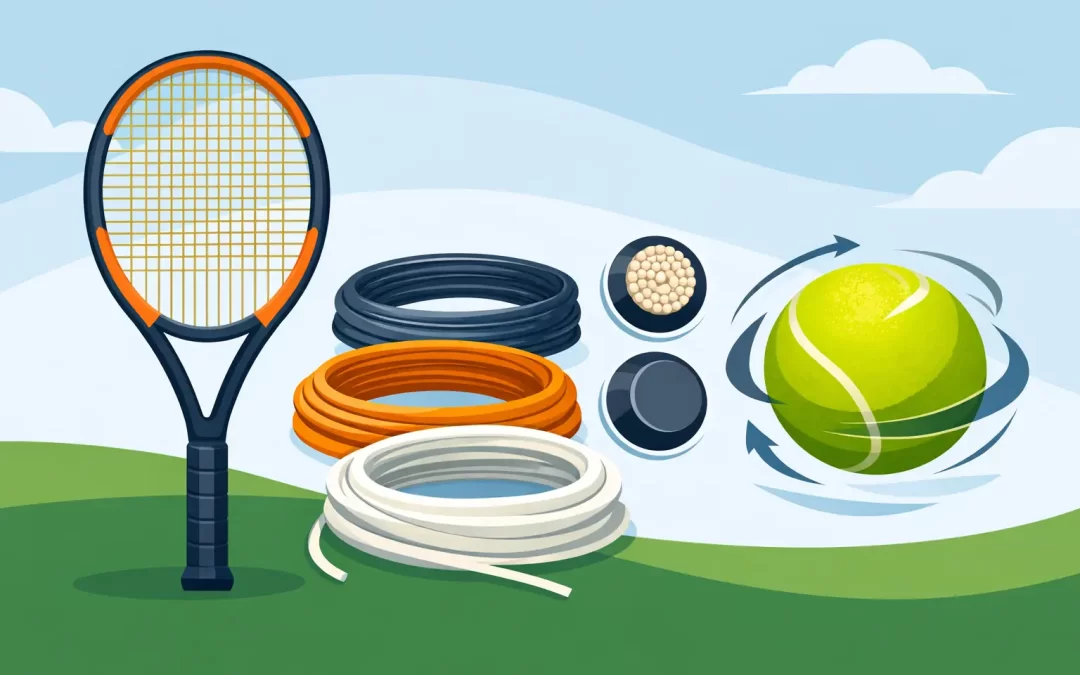
A heavy topspin forehand does not start with the string alone, but the wrong string can absolutely hold your game back. If you are looking for the best tennis string for spin, the real answer is not one universal model. It is the string that lets your racquet head speed, swing path, and contact point work together without sacrificing too much control or feel.
That matters because spin is not just about making the ball jump. It is how modern players create margin over the net, pull the ball down inside the baseline, defend from tough positions, and hit with pace without losing control. The right setup helps you swing more aggressively and trust the ball to dip. The wrong one can feel dead, launchy, harsh, or unstable after only a few hours.
What actually makes a tennis string spin-friendly?
Players often assume spin comes from a rough or shaped string biting the ball. That is only part of the picture. In real match play, spin comes from a combination of snapback, friction management, and your ability to swing fast with confidence.
Snapback is the big one. When the main strings slide out of place and then snap back into position at contact, they help add rotation to the ball. That is why many polyester strings dominate the spin conversation. They are firm, low-powered, and designed to move and recover better than softer string types.
Shape matters too. A round poly can still produce excellent spin if it slides and snaps back efficiently, but shaped co-polys often give players more ball bite and a more aggressive response. The trade-off is that some shaped strings notch faster, lose playability sooner, or feel firmer on off-center contact.
String gauge also plays a role. Thinner strings, such as 17 or 18 gauge, usually offer more bite and a livelier response. Thicker gauges tend to last longer and feel more controlled, but they can give up a little spin potential. For many players chasing spin, going one gauge thinner is one of the easiest adjustments to test.
Best tennis string for spin by string type
Co-polyester is still the top choice
If your priority is maximum spin potential, co-polyester is the category to start with. It gives advanced and intermediate players the best mix of snapback, control, and durability. This is especially true for players with full swings who generate their own pace.
Shaped co-polys are usually the first recommendation for heavy topspin baseliners. Strings with square, pentagonal, or hexagonal profiles tend to grab the ball more aggressively and reward fast acceleration. They pair well with modern racquets and windshield-wiper forehands.
Round co-polys should not be overlooked. Many competitive players prefer them because they deliver more predictable launch, better tension maintenance, and cleaner string movement. If you hit with a lot of spin but also flatten out your backhand or serve, a round poly can feel more balanced over time.
Profilex Performance Co-Poly fits naturally into this conversation because that type of string is built for the player who wants control, durability, and confident acceleration. That is the formula most spin hitters need.
Hybrid setups make sense for many club players
A full bed of poly is not automatically the best option for everyone. If you are a 3.0 to 4.0 player, a junior still developing strength, or an adult managing arm sensitivity, a hybrid can be the smarter move.
Putting a polyester in the mains with a softer cross can preserve some spin benefits while improving feel and comfort. This setup gives you a more forgiving response without completely giving up the controlled, spin-friendly behavior that makes poly so effective.
There is a trade-off. Hybrids usually do not maintain the same level of spin consistency or durability as a full poly setup, especially for frequent hitters. But for many players, the better feel is worth it.
Multifilament and synthetic gut are not spin strings first
Can you hit spin with multifilament or synthetic gut? Of course. Good technique always matters more than packaging. But if you are comparing string categories purely on spin performance, these are not usually the leaders.
They tend to move more, stay displaced longer, and generate less reliable snapback than co-polyester. They can still be a solid choice for beginners, comfort-focused players, or anyone who needs easier power. Just be honest about what you want most. If spin is the priority, these are usually a compromise.
How to choose the best tennis string for spin for your game
If you are a competitive baseliner
Start with a full bed of shaped or slick co-poly in a 16L or 17 gauge. You want a string that lets you swing hard, attack the ball above net height, and trust the ball to drop. This type of player usually benefits from lower-powered strings with strong directional control.
If your current setup feels too boardy, do not assume you need to leave poly entirely. You may just need a softer co-poly, a thinner gauge, or a slightly lower tension.
If you are an all-court player
You still need spin, but not at the expense of touch and transition play. A round co-poly or a softer shaped poly often makes more sense than the stiffest, sharpest option on the wall. You want enough bite for heavy rally balls and kick serves, while keeping feel on volleys and slice.
For many all-court players, the best string is the one that does several things well, not the one that wins a spin lab test by a small margin.
If you are a junior or a parent buying for one
Be careful not to over-string for control. Juniors often want what higher-level players use, but a stiff full poly at the wrong tension can make the racquet feel demanding and uncomfortable. If the player has strong mechanics and swings fast, poly can make sense. If not, a hybrid or softer setup may support better development.
Spin matters, but so do confidence, depth, and arm health.
If comfort is a concern
This is where the phrase best tennis string for spin needs context. The spinniest string on paper is not the best choice if it leaves your arm sore or forces you to shorten your swing. A softer co-poly, lower tension, or hybrid setup often gives better real-world performance because you can keep swinging freely.
Tension matters as much as the string itself
Many players switch strings when tension is the real issue. Lower tension usually helps the ball pocket a bit more and can improve snapback, which supports spin. Higher tension can sharpen control, but if you go too high with a stiff poly, the response can get harsh and underpowered.
For most modern co-polys, the sweet spot is often lower than players expect. If you are stringing poly in the upper 50s and not getting the spin or comfort you want, dropping a few pounds can change the entire response. The racquet, string pattern, and your swing speed all affect the ideal number, so testing matters.
Common mistakes players make when chasing more spin
The first mistake is choosing the stiffest, most aggressively shaped poly without considering playing level. If you cannot bend the string bed with your swing speed, you are not getting the full benefit.
The second is leaving strings in too long. Dead poly stops performing the way it should. Even if it has not broken, it can lose elasticity, feel harsher, and stop snapping back effectively. That means less spin, not more.
The third is blaming the string for a technique issue. Strings can amplify your strengths, but they do not replace racquet head speed, good spacing, or solid contact. The best setup supports your game. It does not create it from nothing.
So what is the best tennis string for spin?
For most serious players, the answer is a quality co-polyester, usually in a shaped or slick profile, matched to the right gauge and tension. That is the most reliable path to heavy topspin, better control on full swings, and the confidence to play aggressively.
But the better answer is more specific. The best tennis string for spin is the one that fits your level, swing speed, comfort needs, and racquet setup. A 4.5 baseliner, a competitive junior, and a 3.5 doubles player should not all be using the same string just because it has a spin-first reputation.
If you want more spin, start with the category that gives you the highest upside, then fine-tune from there. Test gauge before you chase exotic shapes. Adjust tension before you abandon a string completely. And choose a setup that lets you swing with conviction, because that is when spin becomes a weapon instead of a wish.
The right string should make your game feel sharper, not harder. When you find that balance, you are not just adding RPMs – you are defining your style of play with every swing.