
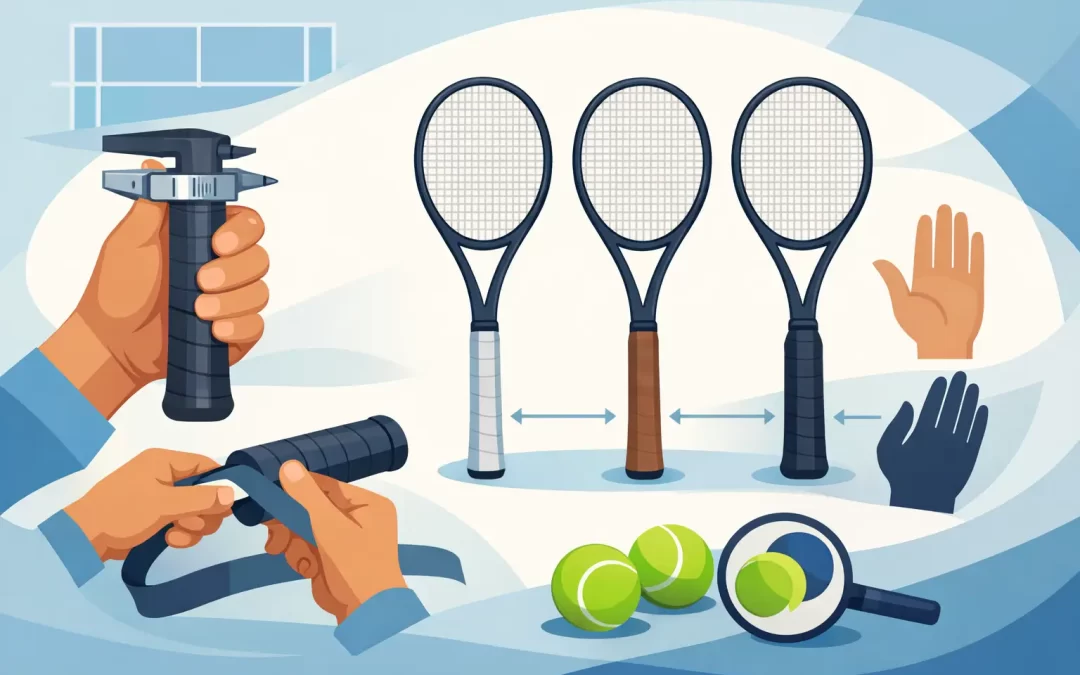
A grip that is slightly off can change far more than comfort. Too small, and many players squeeze harder, overwork the forearm, and lose stability on contact. Too big, and it becomes harder to release the hand naturally, generate racquet head speed, and shape the ball. If you’re figuring out how to choose tennis racquet grip size, you’re not picking a minor spec – you’re making a performance decision that affects control, spin, comfort, and confidence.
Why grip size matters more than most players think
Players often obsess over head size, string pattern, and weight, then treat grip size like an afterthought. That is usually a mistake. Your hand is the only direct connection to the racquet, so the fit of that handle influences how cleanly you swing and how relaxed you stay through contact.
A correct grip size helps you hold the racquet securely without excess tension. That matters on serves, where a tight hand can restrict pronation, and on groundstrokes, where too much grip pressure can make timing feel rigid. It also matters on touch shots. Volleys, slices, and drop shots all get harder when the handle does not sit naturally in your hand.
There is also a durability issue for the body. An incorrect size will not automatically cause injury, but it can push players toward compensations. Reaching for stability with a death grip is one of the most common ones. Over time, that can contribute to hand, wrist, forearm, or elbow discomfort.
How to choose tennis racquet grip size with simple at-home checks
The most useful starting point is to combine measurement with feel. Numbers get you close. Hitting and hand comfort tell you if the fit is actually right.
In the US, adult tennis racquet grip sizes are usually labeled 4, 4 1/8, 4 1/4, 4 3/8, 4 1/2, 4 5/8, and sometimes 4 3/4. These are often also shown as grip sizes 0 through 5, depending on the brand. Most adult players fall somewhere between 4 1/4 and 4 1/2.
One common way to estimate size is the index finger test. Hold the racquet in a standard forehand grip. There should be roughly enough space to fit the index finger of your non-hitting hand between your fingertips and the base of your palm. If there is no room, the grip is probably too small. If there is a large gap, it is probably too big.
The second method is measuring from the middle crease of your palm to the tip of your ring finger. That number, in inches, gives you a general grip-size starting point. If the measurement is around 4 3/8 inches, start by trying a 4 3/8 grip. It is not perfect, but it gets many players into the right range quickly.
These methods are useful, not absolute. Hand shape matters. Finger length matters. Playing style matters too. A heavy topspin baseliner may prefer a slightly different feel than a doubles player who values quick grip changes and touch at net.
Start smaller if you’re between sizes
If you are stuck between two sizes, the safer move is usually the smaller one. You can build up a grip with an overgrip or, in some cases, a thicker replacement grip. Making a grip smaller is much harder.
That does not mean every player should size down aggressively. Go too small and the racquet can twist more at contact unless you squeeze harder. That often defeats the purpose. The smarter approach is to choose the smaller option only when both sizes feel plausible.
For example, if a 4 1/4 feels just a touch compact and a 4 3/8 feels slightly full, many players will perform better starting with the 4 1/4 and adding an overgrip. That gives you room to fine-tune the feel instead of locking yourself into a handle that already feels bulky.
Overgrips and replacement grips change the fit
This is where many players get tripped up. They buy a racquet, then add their preferred grip setup, and suddenly the handle no longer feels like the size they tested.
An overgrip typically adds about 1/16 of an inch to the grip circumference, though it varies by brand and thickness. A replacement grip can also change the effective size depending on whether it is cushioned, thin, ribbed, or leather. If you know you always use an overgrip, factor that into your decision from the start.
This matters even more for juniors moving into adult frames and for players who are very sensitive to handle shape. A grip can measure correctly on paper and still feel wrong once the final setup is installed.
Signs your tennis racquet grip size is too small
A grip that is too small usually shows up in the hand before it shows up on a sizing chart. You may notice the racquet twisting on off-center contact, especially on returns or heavy incoming pace. You may also feel the urge to clamp down harder during rallies.
Some players see extra wear on the palm from constant tension. Others notice forearm fatigue after serving or hitting topspin for long stretches. If you feel like you are always fighting to stabilize the racquet, the grip may be undersized.
There is a trade-off here. Some advanced players like the maneuverability and wrist freedom of a slightly smaller grip, especially for spin production. That can work if they have sound mechanics and enough strength to control the racquet without straining. For most players, though, too small is only helpful up to a point.
Signs your tennis racquet grip size is too big
A grip that is too big tends to feel less lively in the hand. Grip changes can slow down, especially when moving from forehand to continental on serves, returns, and volleys. You may feel late getting the racquet into the right position, not because your footwork is poor, but because the handle is harder to manage quickly.
Players with oversized grips often struggle to create a relaxed whipping motion. The hand cannot wrap as naturally, so the swing can feel stiff. Serves may lose some snap. Topspin can feel harder to produce. Touch shots can come off less precise because the handle sits more like a block than an extension of the hand.
The bigger concern is that many players assume a larger grip is automatically better for comfort. Sometimes it is. Sometimes it simply reduces wrist mobility and creates a different type of tension. Comfort comes from fit, not size alone.
Juniors, women, and men should not size by assumption
One of the worst shortcuts in tennis retail is sizing by category. Not every junior needs the smallest adult grip. Not every male player needs 4 3/8 or 4 1/2. Not every female player should default to 4 1/4. Hand size varies too much for those assumptions to hold up.
Parents buying for competitive juniors should be especially careful. A junior transitioning to a full-size frame needs a grip they can control through real match swings, not just one they can hold in a store for ten seconds. If they are still growing, leaving a little room to build up with an overgrip can be smart, but buying far too large is not a growth strategy. It is usually a performance mistake.
Handle shape can change the feel even in the same size
Grip size is not the whole story. Different brands can feel different even when the labeled size matches. That is because handle shapes vary. Some are more rectangular. Some are more rounded. Some make bevels feel more defined, which can help certain players find grips faster.
If you have ever switched brands and thought, this 4 3/8 does not feel like my old 4 3/8, you were probably right. The actual circumference, pallet shape, grip material, and overgrip thickness all contribute to the final feel.
That is why experienced players do not chase the printed number alone. They pay attention to how the racquet sits in the hand during serves, returns, and rapid grip changes. That is where real fit shows up.
The best way to confirm your choice on court
If possible, hit with the racquet before you commit or compare it against your current frame. Start with mini tennis and volleys, then move back and hit full groundstrokes, serves, and returns. Pay attention to your natural grip pressure. If the racquet feels secure without squeezing, you are close.
Next, test the moments where grip issues usually appear. Hit a few defensive balls when the contact is not perfect. Hit high forehands with spin. Hit second serves. Hit quick reaction volleys. An incorrect grip size often reveals itself under pressure, not in easy rally balls.
A good fit usually disappears from your awareness. You are not thinking about the handle. You are simply swinging freely and controlling the ball.
When players ask us how to choose tennis racquet grip size, the answer is never just a chart. Start with measurement, account for your overgrip, be honest about how the racquet feels under pace, and respect the difference between secure and oversized. Choose the grip that lets your hand stay relaxed and your racquet stay stable. That is the setup that gives you the best chance to play like a champion today.