
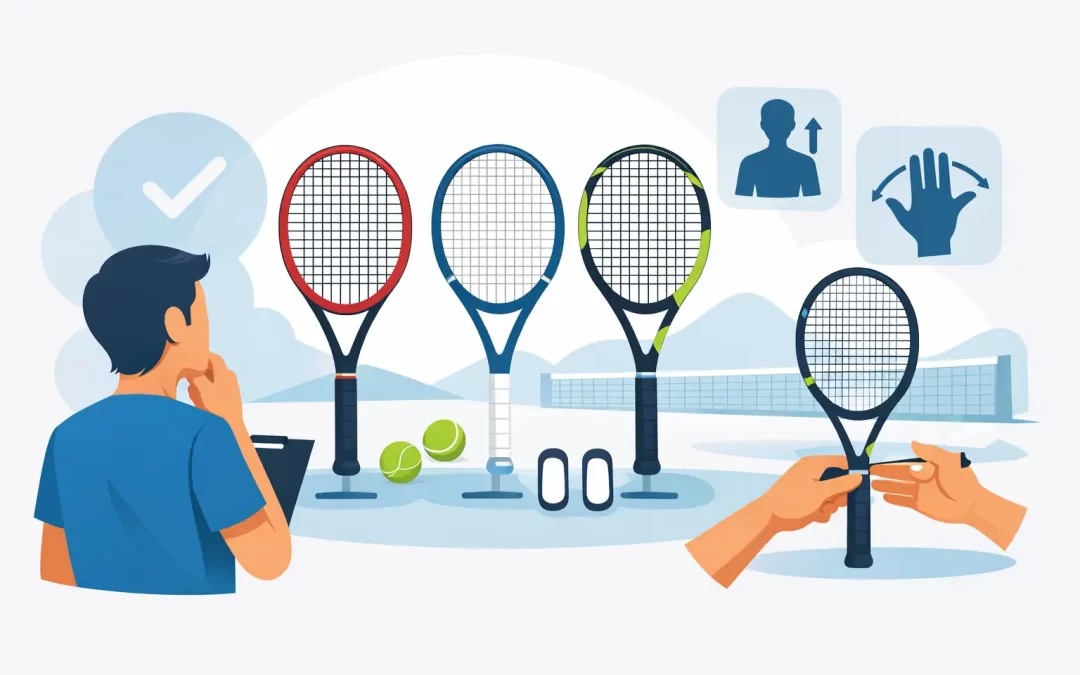
The wrong frame tells on you fast. Balls fly long when you swing freely, short balls sit up when you try to attack, and your arm starts talking back after a long hitting session. That is why choosing tennis racquets is not about chasing a paint job or copying a pro. It is about finding a frame that matches how you swing, how often you play, and what you need the ball to do.
Players usually start with the wrong question. They ask which racquet is best, when the better question is which racquet is best for their game right now. A heavy player frame that feels incredible in the hands of a strong tournament player can feel demanding and late for a 3.5 club player. A light, powerful frame that helps a newer player clear the net can feel unstable to someone facing bigger pace. Good racquet selection is always about fit.
What tennis racquets actually change on court
A racquet affects four things more than anything else – power, control, comfort, and stability. Every spec you see on a product page feeds into those outcomes.
Power is how easily the racquet helps send the ball through the court. Control is how confidently you can swing out and still keep the ball in your intended window. Comfort comes from how the frame and stringbed transmit shock and vibration. Stability is how solid the racquet feels when the ball hits outside the sweet spot or when you are returning pace.
No racquet maxes out all four. More power often means less precision unless your swing path and string setup keep it in check. More control often means you need to supply more of your own pace. Softer frames usually feel better on the arm, but sometimes give up a little crispness. Heavier frames are more stable, but not every player can swing them for two hours and still be on time.
The tennis racquets specs that matter most
Head size
Head size changes forgiveness and launch. Larger heads, usually 100 square inches and above, tend to offer a bigger sweet spot and easier depth. That makes them popular with recreational players, improving juniors, and many modern baseline players.
Smaller heads, often 98 square inches or below, usually deliver a more connected, precise response. Stronger players often like that because they generate their own pace and want tighter feedback on flatter drives, returns, and directional changes. The trade-off is simple – more precision, less margin for late contact.
Weight and swingweight
Static weight is what the racquet weighs on a scale. Swingweight is how heavy it feels when you actually swing it. Players often focus on the listed weight and ignore the more important question: can I accelerate this frame through contact repeatedly?
A heavier, higher-swingweight racquet usually gives you better plow-through, more stability, and a heavier ball. That is a real advantage against pace. But if the frame slows your swing or makes you late on returns, those benefits disappear. A lighter frame is easier to maneuver and can help with racquet-head speed, especially on serves and quick exchanges, but it may flutter more against hard hitters.
Balance
Balance tells you where the mass sits. Head-light racquets tend to feel quicker through the hitting zone and easier to maneuver at net. Head-heavy or more evenly balanced frames can offer easier power, especially for players with shorter swings. Again, it depends on the player. A baseline grinder may love a setup that drives through the ball. An all-court player may want something faster in hand for volleys and reaction shots.
Stiffness
Stiffer frames usually return more energy to the ball, which can translate to easier power. They also tend to feel firmer at impact. Softer frames often feel more muted and arm-friendly, with a bit more dwell time on the strings.
This is where comfort matters. If you have elbow or wrist sensitivity, do not treat stiffness as a minor detail. Frame feel, string type, and tension all work together. Plenty of players blame the racquet when the real problem is a harsh string setup inside it.
String pattern
An open string pattern can help with spin and launch, while a denser pattern often gives a more controlled, predictable trajectory. But string pattern is not a stand-alone answer. A 16×19 pattern in a control-oriented frame does not behave the same way as a 16×19 pattern in a powerful, stiff one.
Match the frame to your style of play
The best buying decisions happen when players are honest about what their game actually looks like, not what they want it to look like six months from now.
If you are a newer player or a casual competitor, you will usually benefit from a racquet that offers easy depth, a generous sweet spot, and manageable weight. You need help building confidence on contact. A frame that is too demanding can make you swing tentatively, and tentative swings rarely produce better tennis.
If you are an intermediate all-around player, versatility matters. You want enough power to finish short balls, enough control to rally with shape, and enough comfort to train consistently. This is the category where small spec differences can make a big impact. A few grams of weight, a slightly lower stiffness, or a more arm-friendly string can turn a good racquet into the right one.
If you are a stronger baseliner with fast strokes, you may prefer a control-oriented frame with a stable response and enough mass to absorb pace. That does not automatically mean the heaviest or smallest-head option. Modern topspin players still need net clearance and racquet-head speed. The key is finding a frame that lets you swing aggressively without losing your strike zone.
If you are an all-court player, doubles specialist, or serve-and-volleyer, maneuverability becomes a bigger priority. Quick handling at net, reliable placement on serves, and a solid feel on returns matter as much as baseline power. Many players in this group play their best tennis with a racquet that feels fast but not flimsy.
Strings matter almost as much as the frame
A great racquet with the wrong string setup can feel average in a hurry. This is one of the biggest mistakes players make. They switch frames when a string change would have solved the problem for a lot less money.
Polyester strings usually give stronger players the spin, control, and durability they want, but they can feel firm and demanding, especially at higher tensions. Multifilament and synthetic gut options are often better for comfort, touch, and easy power. Hybrids sit in the middle and can be a smart answer for players who want a blend of control and feel.
Tension changes the response too. Higher tension generally lowers launch and firms up the stringbed. Lower tension can open up easier depth and a livelier response. Neither is automatically better. A player who sprays balls long with a powerful frame may need a tighter, more controlled setup. A player struggling to generate depth may need the opposite.
This is where expert guidance matters. At Profilex, racquet and string selection are treated as one performance decision, not two separate purchases. That is how players choose smarter and get more from the gear they already own.
Common mistakes when buying tennis racquets
The first mistake is buying for level instead of swing. A 4.0 player with compact mechanics may need more help from the frame than a 3.5 player with natural racquet-head speed. Ratings do not tell the whole story.
The second mistake is overestimating how much racquet you can handle. A frame can feel great for 20 minutes and become work after a full match. If your contact point drops late in the second set, your racquet choice is part of the conversation.
The third mistake is ignoring comfort. Many players can tolerate a harsh setup for a while, until they cannot. If your arm feels beat up after routine hitting, do not normalize it.
The fourth mistake is changing too many variables at once. If you switch racquet, string type, and tension together, you will not know what actually improved or hurt your game. Smart testing is controlled testing.
How to narrow your options fast
Start with your current racquet and define the real issue. Are you missing long, lacking depth, struggling with stability, or dealing with arm discomfort? Be specific. Vague goals lead to vague choices.
Then identify the one or two specs most likely to help. If you need more stability, look at weight and swingweight. If you need easier power, look at head size, stiffness, and string setup. If comfort is the priority, start with softer frames and friendlier strings.
Finally, think about the tennis you play most often. Singles grinders, doubles players, competitive juniors, and weekend hitters do not all need the same response. The best racquet is the one that helps you execute under your real match conditions, not just the one that feels impressive in the parking lot.
The right frame does not play tennis for you. It supports your timing, rewards your strengths, and gives you a cleaner answer under pressure. Choose with that standard, and your equipment stops being a question mark and starts becoming part of your edge.