
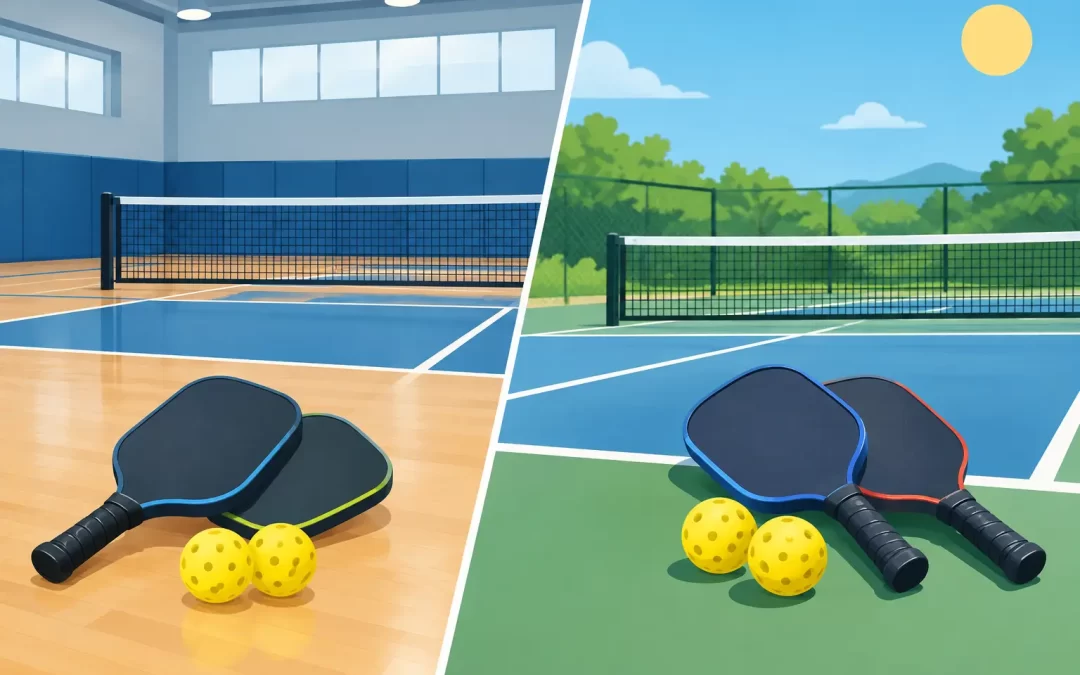
A pickleball can look like a simple piece of plastic until it skips sideways off the court, cracks during a cold-weather game, or turns a clean drive into an unforced error. That is why indoor vs outdoor pickleballs is not a minor equipment choice. The ball determines how fast rallies move, how much the wind affects play, how your paddle feels at contact, and how reliably you can execute under pressure.
Players who use one ball everywhere often end up adapting their technique to bad conditions instead of choosing equipment that supports their game. The right ball will not fix poor footwork or replace practice, but it will give you a more predictable response on every serve, dink, reset, and passing shot.
Indoor vs Outdoor Pickleballs: The Core Difference
Indoor and outdoor pickleballs are built for different environments. Indoor balls are designed to move consistently in still air and to play well on smoother gym floors or indoor court surfaces. Outdoor balls are made to hold their line through wind, handle rougher surfaces, and survive more aggressive impact over time.
The easiest way to spot the difference is the hole pattern. Indoor balls usually have fewer, larger holes. Outdoor balls typically have more, smaller holes. That design change affects airflow, bounce, speed, and feel far more than many players expect.
An indoor ball generally feels softer and quieter off the paddle. It can reward touch, placement, and controlled hands at the kitchen line. An outdoor ball is usually firmer, faster, and more demanding. It produces a crisper sound, travels with more pace, and exposes late contact quickly.
Neither is automatically better. The better ball is the one that matches the court and the kind of pickleball you want to play.
Hole Pattern and Wind Resistance
Outdoor pickleballs have more holes because they need to resist wind movement. Smaller holes reduce the amount of air passing through the ball in a way that helps it stay more stable during outdoor play. A quality outdoor ball still moves in heavy gusts, of course, but it is far more dependable than an indoor model when conditions are changing point to point.
That stability matters on serves and returns. With an outdoor ball, you can swing more confidently through a deep serve or drive because the ball is less likely to float unexpectedly. It also helps when you are defending a hard shot, since the bounce and trajectory tend to be more repeatable on textured outdoor courts.
Indoor balls use larger holes to create a softer, more controlled flight in a wind-free environment. They can feel easier to track in slower exchanges and may encourage longer dink rallies. Bring that same ball outdoors, however, and even a moderate breeze can make it drift, wobble, or die short.
Weight, Speed, and Paddle Feel
Pickleballs must fall within an official weight range, but small differences in construction can change how they perform. Outdoor balls tend to feel denser and firmer at impact. They come off the paddle face quickly, particularly when paired with a power-oriented paddle that has a stiff face and a responsive core.
For aggressive players, that speed can be an advantage. A firm outdoor ball rewards compact swings, early preparation, and accurate targeting. It can make speed-ups more effective and give drives more penetration through the court. The trade-off is that touch shots require cleaner hands. If your grip pressure is too tight or your paddle face is slightly open, the ball can launch higher than intended.
Indoor balls often provide a more muted response. They are not necessarily slow, but they usually feel less explosive. This gives players a little more time to react at the net and can make soft drops easier to calibrate. Players who rely on patience, spin variation, and placement may enjoy this feel, especially during indoor open play.
Your paddle matters here. A control-focused paddle can help tame a fast outdoor ball, while a softer indoor ball may feel underpowered with a low-pop paddle. Equipment should work as a system, not as isolated purchases.
Bounce and Court Surface Matter
The surface under the ball changes the equation. Outdoor pickleball is commonly played on acrylic, asphalt, or concrete courts. These surfaces are harder and often more textured, producing a lively but consistent bounce with a durable outdoor ball.
Indoor courts may be wood, sport tile, or another smooth gym surface. The ball can skid more, bounce lower, or respond differently depending on the floor. An indoor ball is built to provide a more suitable balance of grip and bounce in those conditions.
Do not assume every indoor facility plays the same. A polished hardwood court can feel dramatically faster than a dedicated indoor pickleball surface. If you play league matches at one location and practice at another, test the ball used in competition before match day. A few minutes of familiarization can sharpen your return depth, third-shot drop timing, and transition-zone resets.
Durability: Why Outdoor Balls Crack
Outdoor balls face more punishment. Rough courts scrape the plastic, hard impacts put stress on the seams, and temperature swings make the material less forgiving. Cracking is especially common in cold weather, when plastic becomes more brittle.
A cracked ball is not just an inconvenience. Once the shape or seam is compromised, its bounce and flight become unreliable. Competitive players should replace it immediately rather than practicing around a ball that no longer performs correctly.
Indoor balls often last longer because indoor surfaces are gentler and conditions are stable. Still, they can go out of round, soften, or split with repeated hard play. Durability varies by brand, manufacturing consistency, weather, and how hard your group hits the ball. Players with heavy drives and quick hands will wear through balls faster than recreational groups focused on touch rallies.
For outdoor sessions, bring extras. Keeping several fresh balls in your bag prevents a cracked ball from cutting practice short or turning a competitive game into a guessing contest.
How Temperature Changes Ball Performance
Temperature is one of the most overlooked factors in pickleball. In hot weather, balls can feel livelier and softer. They may bounce higher, fly faster, and become more prone to warping over long sessions. In cold conditions, the same ball can feel hard, dead, and vulnerable to cracking.
Outdoor players should expect to adjust. On a cold day, give yourself more margin over the net on drops and dinks because the ball may not rebound as energetically. On a hot day, be ready for faster hands battles and deeper drives. Keeping balls out of extreme heat in the trunk of a car also helps preserve their shape and lifespan.
Indoor facilities remove wind from the equation, but temperature still affects feel. A cool gym can make an indoor ball play firmer than expected, while a warm, busy facility may make it feel softer and more responsive.
Which Pickleball Should You Buy?
Start with where you play most often. If the majority of your games are outside, buy outdoor balls. If you play in a gym or dedicated indoor facility, choose indoor balls. That straightforward decision will deliver better results than trying to force one type to cover every situation.
If you compete, use the ball specified by your league, tournament, or club whenever possible. Tournament play is not the time to discover that your usual practice ball feels slower, harder, or less predictable than the approved model. The ball affects spin, reset control, and pace, so familiarity is a real competitive advantage.
Players who split time between indoor and outdoor courts should keep both types available. Label them in your bag and avoid mixing them during a session. Once several ball types get tossed into the same hopper, practice quality drops because every shot comes off the paddle differently.
Build Confidence Through Consistent Equipment
Better pickleball is built on repeatable contact. You want to know how the ball will react when you attack a high dink, absorb a body shot, or shape a third-shot drop into the kitchen. The correct ball gives you that feedback.
At Profilex, the approach is simple: choose gear that supports the way you compete, not gear that forces you to compromise. Match your ball to your environment, bring fresh backups for serious play, and spend your attention on the next point instead of wondering what the equipment will do.