
A fast swing can make the wrong string feel worse than the wrong racquet. That is why the polyester versus multifilament strings decision deserves more than a quick look at a package label. These two string families react very differently at contact, and the better choice depends on how hard you swing, how often you break strings, and what your arm tells you after a long match.
Polyester gives modern, aggressive players the confidence to swing through the ball. Multifilament gives players easier depth, a softer response, and welcome relief when comfort is the priority. Neither is automatically superior. The winning setup is the one that lets you take your normal swing with conviction.
Polyester Versus Multifilament Strings: The Core Difference
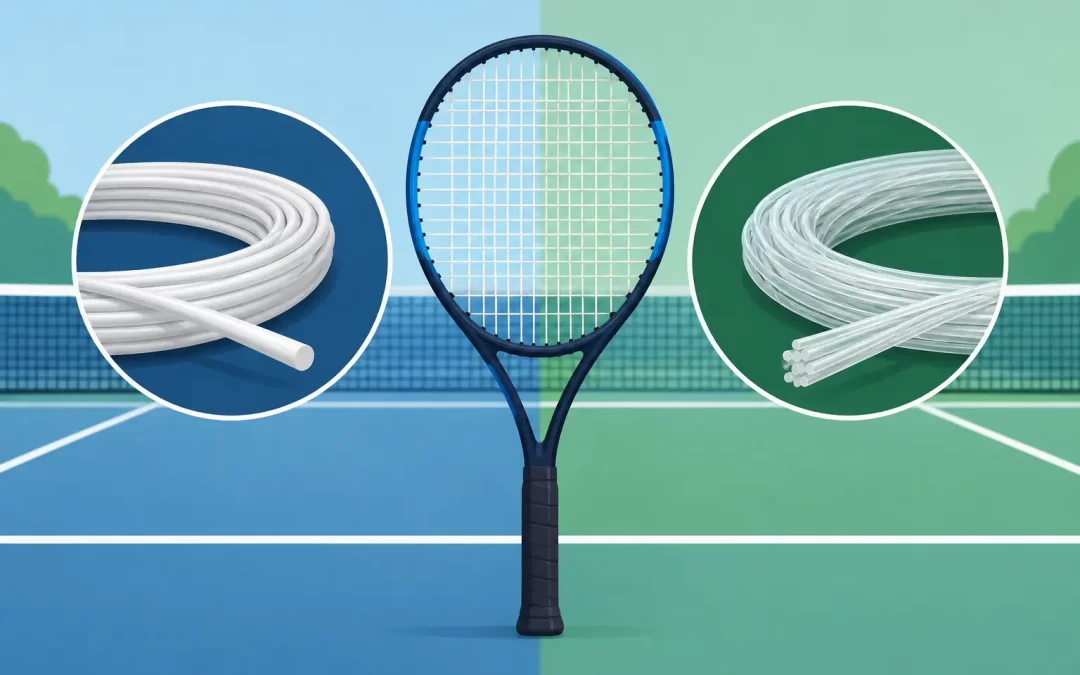
Polyester, often called poly or co-poly, is a firm monofilament string. It is built from a single solid filament and designed to resist movement, control powerful strokes, and support spin-heavy ball striking. Many competitive players choose it because it feels predictable during full swings. A shaped co-poly can also enhance bite on the ball, especially for players who create heavy racquet-head speed.
Multifilament strings are made from many fine fibers bonded together. Their construction is designed to imitate some of the elastic, cushioned response associated with natural gut. The result is a livelier, more forgiving string bed that helps the ball leave the racquet with less effort.
The difference shows up immediately. Polyester feels lower powered and more connected to a hard, fast swing. Multifilament feels softer, springier, and more helpful when your stroke is compact or you are defending from behind the baseline. One favors control through restraint; the other provides power through elasticity.
Why Polyester Appeals to Big Hitters
Polyester is the practical choice for many advanced baseliners, frequent string breakers, and players who attack the ball with topspin. Its lower power helps keep aggressive shots inside the lines. If you routinely overhit with a softer string, poly can give you the margin to accelerate harder without feeling like every forehand will fly long.
Spin is another major benefit, although the claim needs context. Polyester does not create topspin by itself. It allows the mains to slide and snap back more readily, which can increase the rotational force on the ball when the player already brushes up aggressively. A player with a flat, slower swing will not suddenly produce a heavy ball just by switching to a shaped poly.
Durability matters, too. Players who saw through multifilament quickly may get substantially more life from polyester. That makes it a sensible performance and value decision for high-volume hitters. Profilex Performance Co-Poly strings are positioned for players who want that controlled, spin-ready response without guessing what belongs in a modern baseline setup.
There is a trade-off. Polyester loses tension and resilience as it is played. A set can remain intact while becoming less responsive and less comfortable. Do not judge string life only by breakage. If your once-reliable launch angle becomes erratic, the string bed feels boardy, or your arm feels more beat up than usual, it may be time to restring.
Who should start with polyester?
Start with polyester if you take full swings, generate your own pace, hit with topspin, and break softer strings regularly. It is especially effective for tournament juniors and adult competitors who practice several times a week and want a controlled response under pressure.
It is less suitable as a default for a developing player with short strokes, a player who struggles for depth, or anyone managing recurring elbow, wrist, or shoulder discomfort. Firm strings at high tension can turn a good racquet into an unnecessarily demanding setup.
Why Multifilament Wins on Comfort and Easy Power
Multifilament is the smarter first choice for many recreational players, doubles players, and players returning to tennis after time away. Its elastic fibers stretch and recover efficiently, creating easy depth and a more comfortable impact. On a cold day, late in a third set, or when contact is not perfectly centered, that assistance is noticeable.
Comfort is not just a luxury feature. A more forgiving string bed can reduce harsh vibration and shock reaching the arm. It cannot diagnose or solve an injury, but it is a meaningful equipment adjustment for players trying to reduce unnecessary stress. If you have persistent pain, work with a qualified medical professional and review your technique, racquet weight, grip size, and string setup together.
Multifilament also offers better feel for players who rely on touch. Volleys, slice, short angles, and defensive lobs often come off the strings with more pocketing and feedback. A quality multifilament can make a stiff, control-oriented racquet feel far more playable without changing racquets entirely.
Its limitations are clear for hard hitters. Multifilament can move more, fray sooner, and launch the ball higher than a comparable polyester. A player who attacks with violent topspin may find that it feels great for a few hours but becomes inconsistent or breaks too quickly. That does not make it a bad string. It means its strengths are aimed at a different style of player.
Who should start with multifilament?
Choose multifilament when comfort, power, and feel are higher priorities than maximum durability. It is an excellent match for beginner and intermediate players, all-court players who do not break strings often, and experienced competitors who want to protect their arm without sacrificing a responsive feel.
A player using a lightweight, stiff racquet should give multifilament serious consideration. That combination can otherwise feel sharp and underpowered on off-center contact, particularly when paired with a firm string at high tension.
Tension Changes the Answer
String type is only half the decision. Tension can either support the benefits you want or erase them. The same polyester strung too tight can feel dead and punishing. The same multifilament strung too loose can feel overly lively and difficult to control.
For polyester, many players benefit from starting below the middle of their racquet’s recommended range. Lower tension can add pocketing, comfort, and useful rebound while retaining the controlled character that makes poly attractive. A reasonable starting point for an experienced full-swing player is often 44 to 50 pounds, though racquet pattern, gauge, and personal preference all matter.
For multifilament, starting closer to the middle or upper-middle of the recommended range often helps contain its power. Many players find a useful starting window around 52 to 58 pounds. If shots are landing short, lower the tension a few pounds. If you are spraying long despite clean contact, raise it slightly before abandoning the string entirely.
Change one variable at a time. If you switch from a 16-gauge multifilament at 57 pounds to a 17-gauge polyester at 46 pounds, you are changing material, gauge, and tension at once. You will learn far more by making a controlled adjustment and taking notes after a few hitting sessions.
The Hybrid Option for Players Caught in the Middle
If polyester delivers the control you want but leaves your arm unhappy, a hybrid can be the right answer. The classic setup uses polyester in the mains for durability and spin, with multifilament in the crosses for added comfort and feel. Since the mains influence much of the string bed’s playing character, this arrangement still leans controlled and spin-friendly.
Players who want a softer, more powerful response can reverse that layout: multifilament mains and polyester crosses. This can improve comfort and ball pocketing while the poly cross helps limit string movement. It is not as durable as poly mains, but it can be a strong fit for an all-court player who wants more forgiveness.
Hybrids require realistic expectations. They do not deliver the full softness of a complete multifilament bed or the maximum durability of a complete polyester bed. Their value is in balancing competing needs, not eliminating every compromise.
Make the Choice Based on Your Ball, Not the Pros’ Setup
Professional players have extraordinary racquet speed, precise timing, frequent restringing schedules, and often customized frames. Copying their firm polyester setup can leave a club player working harder for less depth and more arm fatigue. Your string should match the ball you hit on a normal Tuesday night, not the ball you imagine hitting in a highlight reel.
Choose polyester if you swing fast, create your own pace, want spin-friendly control, and restring often enough to keep the response fresh. Choose multifilament if you want comfort, easier power, touch, and a more forgiving ride. If your needs pull in both directions, test a hybrid before making a major racquet change.
The best string job should make you want to swing freely on the biggest point. Start with the setup that supports your game now, then refine tension and gauge as your game gets faster, stronger, and more demanding.