
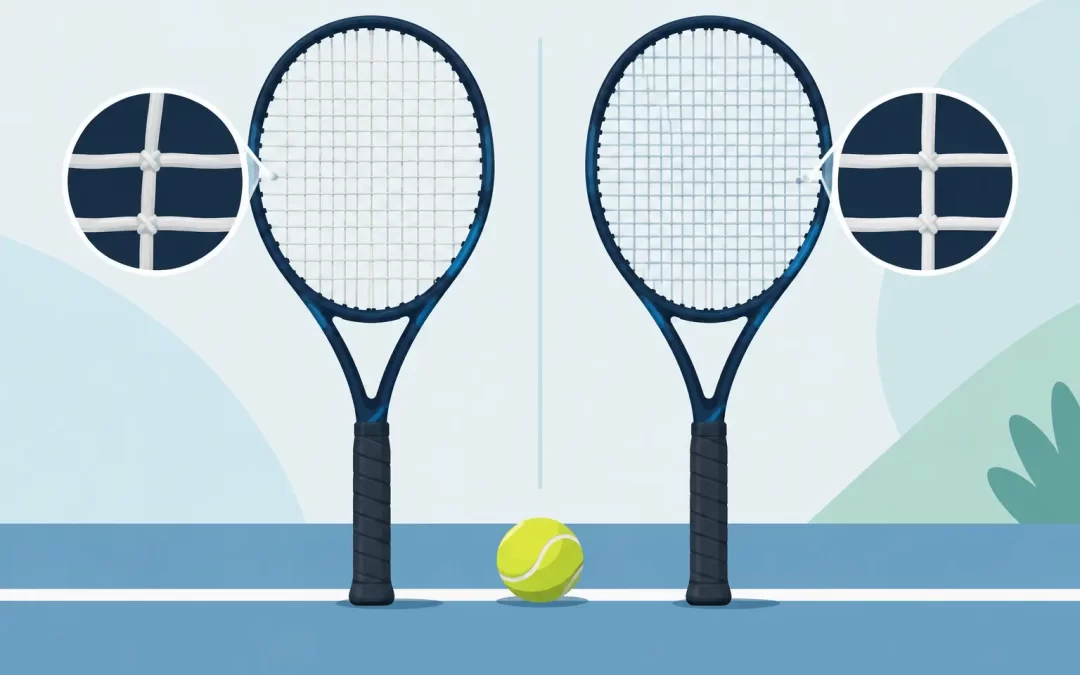
A six-pound adjustment can make a familiar racquet feel like a different tool. This string tension change example compares 52 and 58 pounds using the same string, racquet, and player. The difference is not a marketing detail. It can affect launch angle, ball pocketing, comfort, confidence on aggressive swings, and how long the setup feels playable.
For players who keep missing long, fighting arm discomfort, or wondering why a fresh restring does not feel like the last one, tension is one of the first variables worth examining. The right number is not universal. It depends on your string type, racquet pattern, swing speed, contact point, and the result you want to create.
String Tension Change Example: 52 vs. 58 Pounds
Picture a player using a 16×19, 100-square-inch racquet with a shaped co-polyester string. At 58 pounds, the string bed will generally feel firmer and more controlled at impact. At 52 pounds, it will usually feel more elastic, comfortable, and responsive, with a higher launch angle.
At 58 pounds, the player may notice a more connected, predictable response on full swings. The ball tends to leave the strings with a lower, more controlled trajectory, especially when the player drives through the court. This can be a strong setup for a big hitter who wants to reduce depth and keep flatter attacks inside the baseline.
The trade-off is firmness. A higher-tension polyester setup can feel less forgiving when contact drifts toward the frame or when the player is late. It may also become harsh sooner as the string loses resilience. Players with a history of tennis elbow, wrist irritation, or shoulder discomfort should be careful about pushing a stiff string too high simply because they want more control.
At 52 pounds, that same racquet and string will typically provide more ball pocketing and a livelier response. The player may find easier depth from defensive positions, more comfort on off-center contact, and more available spin because the ball launches higher and the strings can move and snap back more freely. For a player who struggles to create depth or wants a more forgiving feel, six pounds lower can be a meaningful upgrade.
The trade-off at 52 pounds is that a fast, flat ball striker may initially see shots sail long. That does not automatically mean the tension is wrong. It may mean the player needs more spin, a cleaner contact point, or a few sessions to adjust to the higher launch. If the ball is consistently flying, a small increase of two pounds is often smarter than jumping all the way back to 58.
What Changes on the Court
Tension changes do not affect every player in the same way, but the court-level patterns are consistent enough to guide a smart test. Higher tension usually creates a firmer string bed, while lower tension generally creates more pocketing and a softer response.
Control is more than a tight string bed
Many players associate high tension with control, and there is truth behind that. A firmer string bed can reduce the trampoline-like sensation some players dislike, particularly with powerful racquets or lively multifilament strings. It can help an advanced player swing aggressively without feeling as if the ball is jumping unpredictably off the face.
But control also comes from predictable launch, spin, and confidence. If 58 pounds feels too board-like, you may guide the ball instead of accelerating through it. In that case, 54 or 55 pounds can produce better real-world control because you are swinging freely and finishing your strokes. The best tension is the one that lets you commit to your game.
Power and depth can improve at lower tension
A lower tension can help players access easier depth, especially on balls struck outside the sweet spot or when defending behind the baseline. This does not mean a lower number turns every racquet into a power racquet. The effect depends heavily on the string material.
A multifilament or synthetic gut at 52 pounds may feel noticeably more powerful than at 58. A firm co-polyester at 52 may instead feel more playable and forgiving, with a modest change in free power. Polyester is designed for players who generate racquet-head speed, so the bigger benefit of lowering tension is often improved feel and a more usable response rather than raw pace.
Spin and launch angle are connected
Lower tension often produces a higher launch angle, meaning the ball leaves the string bed on a slightly higher trajectory. For topspin players, that can be an advantage. You can clear the net with margin and let the ball dip sharply into the court.
However, a higher launch can frustrate players who naturally hit flat. If your forehand is already direct and linear, dropping from 58 to 52 pounds may require a more deliberate low-to-high swing path. The string is not creating spin on its own. It is giving your swing a different response window.
Comfort is a performance category
Comfort is not just for players managing pain. A more comfortable string bed can help you practice longer, stay relaxed on return, and absorb heavy pace without tightening your hand and forearm. Lowering tension is one of the simplest ways to make a polyester setup less demanding.
That said, tension cannot erase the inherent firmness of a stiff co-poly. If comfort is your priority, consider a softer co-poly, a thinner gauge, a hybrid with natural gut or multifilament, or a full multifilament setup. A player using an arm-friendly string at 55 pounds may be far better off than one forcing a rigid poly down to 45 pounds.
How to Test Your Own Tension Range
Do not change your string, gauge, racquet, and tension all at once. If you do, you will not know which adjustment improved or hurt your performance. Keep the same racquet and string model, then move in two-pound increments.
Start from your current reference tension. If you play at 56 pounds, test 54 pounds next. Use the racquet for at least two hitting sessions, including serves, returns, defensive balls, and pressure points. Pay attention to your depth, not just how the string feels during a warm-up.
A useful test asks four direct questions: Are my aggressive forehands landing deep without sailing? Can I swing freely on second serves? Do I trust the racquet when stretched wide? Does my arm feel better after a full session? Your answers reveal far more than a number printed on a string tag.
If the lower tension gives you more depth but too much launch, move up two pounds. If the higher tension delivers precision but leaves your arm fatigued or your shots short, move down two pounds. Most players find their best range, not one magic number.
String Type Changes the Answer
The 52-versus-58 example becomes more dramatic or more subtle depending on what is in the racquet. Polyester holds its control-oriented character at lower tensions better than many players expect, which is why experienced competitors often string co-poly in the mid-to-low 40s or low 50s. A 52-pound poly setup can still feel controlled in the right racquet.
Multifilament and synthetic gut are more elastic. Raising them to 58 pounds may improve directional confidence, but lowering them to 52 can add noticeable comfort and pop. Natural gut maintains excellent feel and tension stability, yet its power and responsiveness require thoughtful tension selection, particularly in an open-pattern racquet.
Gauge matters, too. A thinner 17-gauge string will usually feel livelier and generate more bite than a thicker 16-gauge version at the same tension. If you want more comfort without losing too much control, changing gauge may be as effective as making a large tension adjustment.
When to Restring Instead of Changing Tension
A fresh 52-pound string bed will not play like a 52-pound bed after several weeks of hard hitting. All strings lose tension, and polyester can lose its elastic response before it actually breaks. When players say their strings feel dead, they are often feeling a loss of resiliency and snapback, not merely a lower number.
If your racquet suddenly feels harsh, unpredictable, or difficult to control after many hours, restringing may solve the issue better than tightening your next job. Competitive players who use polyester should track hitting hours, not just wait for breakage. A string that remains intact is not necessarily performing at its best.
Profilex players often get the best results by treating tension as part of a complete setup: racquet head size, pattern, string material, gauge, and playing style all work together. The goal is not to copy a pro’s number. It is to build a response you can trust under pressure.
Your next restring is a chance to make a deliberate adjustment. Change by two pounds, give the setup a fair on-court test, and let your ball flight, comfort, and confidence tell you where your best tension range begins.