
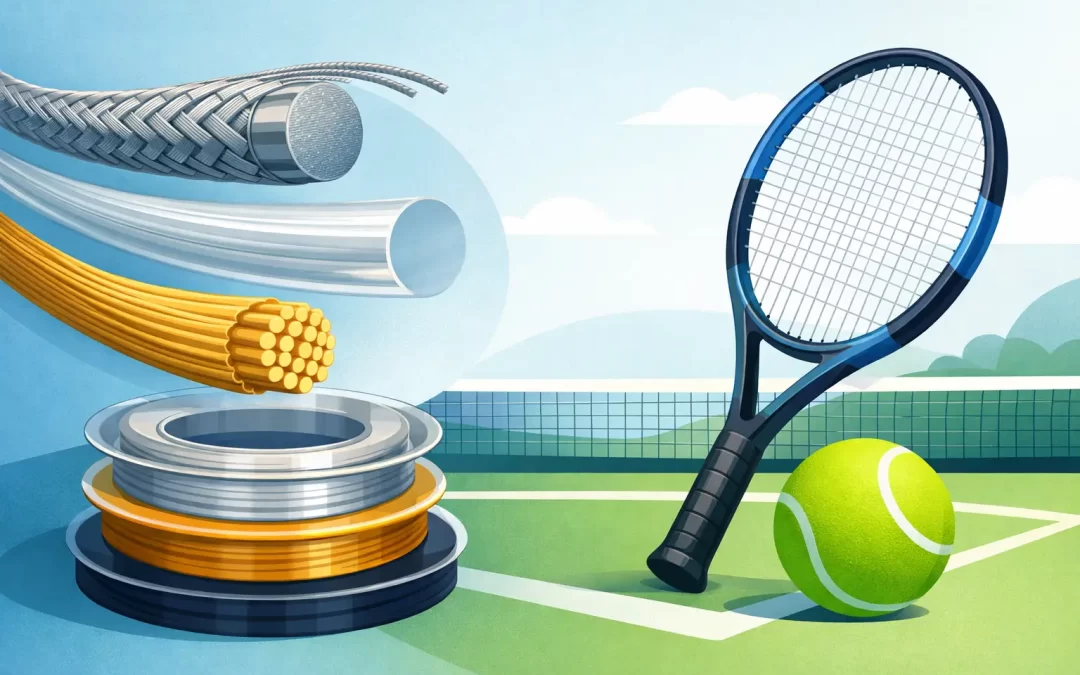
You feel string material on the first clean strike. One setup gives you a crisp, controlled ball that jumps off the court with shape. Another feels softer, deeper, and easier on the arm. That is why a real tennis string materials guide matters – not as gear trivia, but as a performance decision that affects power, spin, comfort, durability, and confidence every time you play.
Most players spend more time comparing racquets than comparing strings, even though strings are the part of the racquet that actually meets the ball. Material changes launch angle, pocketing, feel, tension maintenance, and how much effort it takes to hit your targets. If you want to define your style of play more clearly, start here.
Tennis string materials guide: what changes on court
String material is not just a manufacturing detail. It shapes how the stringbed behaves at contact and how long it keeps that behavior. Two players can use the same racquet and have completely different results simply because one uses polyester and the other uses multifilament or natural gut.
The main trade-off is simple. The strings that offer the most control and spin potential are often firmer and less forgiving. The strings that offer the most comfort and easy power usually sacrifice some durability or precision for hard hitters. There is no perfect material for everyone. There is only the right fit for your swing speed, contact quality, match volume, and physical needs.
Polyester strings
Polyester, including co-poly, is the modern performance standard for aggressive players. If you swing fast, attack with topspin, and want the ball to stay inside the lines when you accelerate, poly is usually the first category to consider. It offers a firmer response, strong control, and the snapback effect that helps generate spin.
This is why advanced juniors, tournament players, and heavy topspin baseliners gravitate toward it. Poly lets you take bigger cuts without feeling like the ball is flying. It also holds up better against string movement and notching than softer materials, which matters if you break strings or play several times a week.
But there is a cost. Polyester is generally less comfortable than other materials, especially at higher tensions or in stiffer racquets. It also goes dead before it breaks for many players. That means the string may still be intact, but the feel gets harsher, the launch gets less predictable, and the spin response falls off.
Co-poly versions improve on traditional polyester by blending additives that make the string more playable. Some are shaped for extra bite, others are smoother for better snapback, and some are built to soften impact slightly. A performance-focused co-poly can be an excellent fit for players who want modern spin and control without the board-like feel older polys were known for.
If you are a big hitter who wants a sharper response and more confidence on full swings, polyester is hard to beat. If you are dealing with arm discomfort or have a compact swing, it may not be your best first choice.
Multifilament strings
Multifilament strings are built to mimic some of the comfort and power of natural gut by using thousands of tiny fibers. The result is a softer, more forgiving feel that many club players love right away. If your goals are arm comfort, easier depth, and a more cushioned response, multifilament is one of the smartest categories in the market.
This material works especially well for recreational players, doubles specialists, seniors, and anyone returning from elbow or shoulder issues. It helps on off-center contact, provides easy pace on medium swings, and gives the stringbed a friendlier feel overall.
The trade-off is durability and control under heavy pace. Strong topspin players can saw through multifilament quickly, and big hitters may find it too lively when they start swinging harder. Tension maintenance can be solid depending on the model, but the stringbed often frays and loses its crispness over time.
That does not make multifilament a compromise string. It makes it a purpose-built one. For many players, especially those below advanced tournament level, better comfort and easier playability lead to better results than chasing maximum spin potential from a full bed of poly.
Natural gut strings
Natural gut remains the premium benchmark for feel, comfort, and tension maintenance. It delivers power without feeling wild, touch without feeling mushy, and a uniquely connected response that many experienced players still consider unmatched.
If you value pocketing, touch shots, and long-lasting playability, natural gut is elite. It performs especially well for all-court players, serve-and-volley players, and anyone who wants premium comfort without giving up too much control. It is also one of the best options for players managing arm issues.
The obvious downside is cost. Natural gut is significantly more expensive than synthetic options. It is also less resistant to moisture and can be a poor fit for players who break strings often. For heavy topspin players on a budget, using full natural gut can be tough to justify even if the performance is outstanding.
That said, natural gut in a hybrid setup can be a smart high-performance solution. Pairing gut with polyester gives you some of the comfort and power of gut with the control and durability of poly. For many competitive players, that blend offers a best-of-both-worlds setup.
Synthetic gut strings
Synthetic gut is often the most practical starting point. It typically uses a solid core with outer wraps and aims to provide a balanced mix of playability, value, and decent durability. It does not dominate any single category the way gut or poly can, but it does many things well enough for a wide range of players.
For beginners, intermediates, and budget-conscious players, synthetic gut is still one of the most useful options in tennis. It offers a cleaner, more direct feel than many entry-level strings and gives players a reliable baseline for judging what they may want more or less of later.
If you are unsure whether you need more power, more comfort, or more control, synthetic gut is a smart reference point. The main limitation is that serious competitors often outgrow it. Once swing speed rises and performance demands become more specific, players usually move toward poly, multifilament, gut, or hybrids.
Hybrid string setups
A hybrid combines two different string materials, usually one in the mains and another in the crosses. This is where string selection becomes more precise. You are no longer choosing one general feel. You are building a response around your actual game.
The most common hybrid is polyester mains with natural gut or multifilament crosses. That setup gives players control and spin from the mains while adding comfort and feel from the crosses. It is popular with advanced players who want poly performance without the full stiffness of a complete polyester bed.
The reverse hybrid, using gut or multifilament in the mains and poly in the crosses, can produce more comfort and power while still adding some control. It is often a good option for players who want a livelier feel than a standard poly-based hybrid.
Hybrids are especially useful when your game does not fit neatly into one category. Maybe you are a strong baseline player who also wants touch at net. Maybe you need spin, but a full poly setup feels too harsh after two matches. A hybrid lets you tune around those realities instead of forcing a one-material answer.
How to choose the right material for your game
The best tennis string materials guide should make selection easier, not more complicated. Start with your swing. If you generate your own pace and attack the ball aggressively, polyester or a poly hybrid usually makes sense. If you have a moderate swing and want easier depth, multifilament or synthetic gut may help more. If comfort is your top priority, natural gut and multifilament are the strongest choices.
Next, be honest about durability. Players who train hard and break strings regularly need to factor in replacement cost and string life. A soft string that feels great for three sessions may not be practical if you are restringing constantly. On the other hand, a durable poly that feels too firm can cost you in arm health and shot quality.
Finally, think about level and frequency. A junior playing high-volume tournament tennis has different needs than a 4.0 doubles player or a weekend adult beginner. Equipment should support the game you actually play, not the setup you think you are supposed to use.
At Profilex, that is how we look at strings – not as a trend, but as a performance tool. The right material should help you swing with conviction, recover faster, and trust your ball under pressure.
If you are deciding between comfort and control, or spin and feel, that usually means you are close. The last step is choosing the material that makes your strengths show up more often. When your strings match your game, the racquet starts feeling less like equipment and more like an advantage.