
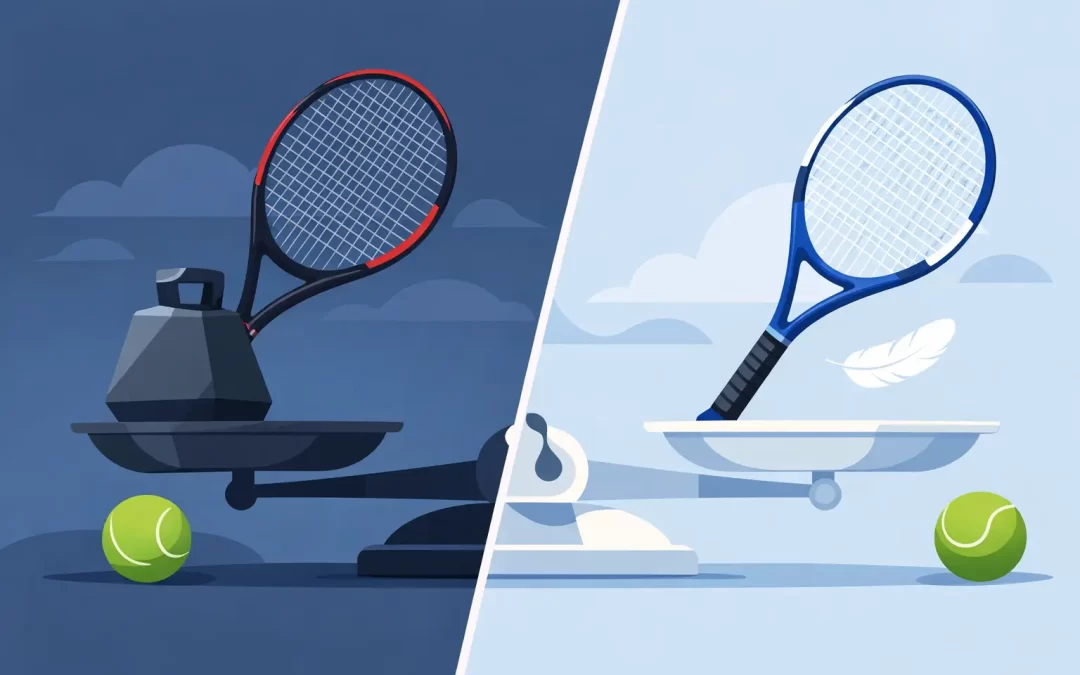
You feel racquet weight before you understand it. A frame can look perfect on paper, but five minutes into a hitting session, the truth shows up in your timing, contact point, and arm comfort. That is why heavy versus light tennis racquets is not a beginner-only question. It matters just as much for strong juniors, league players, and tournament competitors trying to get more out of their equipment.
A lot of players assume heavier means better control and lighter means easier power. There is some truth there, but it is not the whole story. Static weight, swingweight, balance, and string setup all work together. If you want to choose smarter gear and play with more confidence, you need to understand how racquet weight changes the ball you hit and the effort it takes to hit it.
Heavy versus light tennis racquets: what really changes
When players compare racquets by weight, they often mean static weight, or how heavy the frame feels on a scale. On court, swingweight is just as important. Swingweight measures how heavy the racquet feels when it moves through the swing. Two racquets can have similar static weight and play very differently if one carries more mass in the head.
Heavier racquets usually bring more stability at contact. Against pace, they resist twisting better and help the racquet drive through the ball. That often translates to a more solid response on returns, volleys, and groundstrokes hit under pressure. Better players usually notice this right away. The frame feels planted instead of getting pushed around.
Lighter racquets are easier to accelerate. That helps players generate racquet head speed with less effort, especially on serves, quick exchanges at net, and defensive shots when you are stretched wide. For many recreational players, this makes the game feel simpler. You can get the racquet into position faster and recover more easily on the next shot.
The trade-off is that easier acceleration does not always equal a better ball. If a racquet is too light for your swing, contact can feel unstable and your timing can get jumpy against heavier hitters. If a racquet is too heavy, you may love the first half hour and struggle by the second set.
The case for a heavier racquet
A heavier racquet generally rewards clean mechanics and full swings. It gives advanced intermediates and competitive players a steadier platform, which can improve directional control and shot tolerance. When you drive through the court, there is usually more plow-through, meaning the racquet carries momentum through contact instead of getting knocked back.
That matters most in three areas. First, on returns, a heavier frame can absorb pace and send the ball back with a more reliable trajectory. Second, on volleys, extra mass often creates a firmer, more confident block. Third, from the baseline, it can help stronger players hit a heavier ball without over-swinging.
Comfort can also improve with weight. This surprises some players, but a properly matched heavier racquet may transmit less harsh shock than an overly light, stiff frame that twists on impact. Weight alone does not guarantee arm-friendliness, but stability usually helps.
Still, heavy does not mean universally better. If your swing slows down late in matches, if your serve loses speed after a set, or if you feel shoulder fatigue, your racquet may be asking too much from you. A frame only helps when you can swing it efficiently over time.
Why lighter racquets appeal to so many players
Lighter racquets make sense for a large part of the market because they lower the physical barrier to good racquet speed. That is useful for newer players learning timing, doubles players who value fast hands, and anyone who wants easier maneuverability on serve returns and reaction volleys.
They can also help players create spin. Since the frame moves faster, many players find it easier to brush up the back of the ball. On serve, that quicker acceleration can make kick and slice serves more accessible. At the baseline, a lighter setup may help you defend better and reset points when you are pulled off balance.
For juniors moving into full-size frames, lighter racquets can be the right bridge. The same goes for adult players returning to the game after time away or dealing with fitness limitations. There is no prize for using more weight than you can manage. The right racquet is the one that lets you repeat your swing with confidence.
But there is a limit. If the racquet is too light, players often start adding effort where they should be using timing. The result can be a ball that sits up short, a serve that lacks penetration, or off-center contact that feels unstable. You may swing harder and get less.
How to decide which side fits your game
The best question is not heavy or light. It is whether the racquet supports your swing style, physical strength, and match demands.
If you are a stronger player with long, fast swings, a heavier racquet often gives you better payoff. You can handle the mass, use it to stabilize contact, and trust it under pressure. This is especially true for competitive baseliners, aggressive all-court players, and advanced juniors who are physically ready for more frame weight.
If you are a compact swinger, a doubles-first player, or someone who values speed and easy handling, a lighter racquet may be the smarter choice. That does not mean giving up control. It means finding a frame you can move cleanly and consistently.
Your level matters, but your contact quality matters more. A 4.0 player with efficient mechanics may benefit from a heavier setup more than a stronger but less consistent hitter. Age matters too. So does match length. A racquet that feels great in a ten-minute demo can become a liability in a two-hour match.
Heavy versus light tennis racquets for common player types
For beginners, lighter usually works better, but not ultra-light. New players need maneuverability, yet they also need enough stability to learn proper contact. A racquet that is too light can encourage arm-heavy swings and inconsistent timing.
For intermediate club players, the sweet spot is often in the middle. This is where many players find the best balance of stability, comfort, and speed. If you rally regularly, play league matches, and want to improve without fighting your gear, moderate weight is often the safest path.
For advanced players and serious juniors, heavier frames become more attractive because they hold up better against pace and reward full acceleration. If your game is based on taking the ball early, redirecting pace, or hitting through the court, added weight can be a real advantage.
For players with arm concerns, the answer depends on the whole build. A heavier racquet can be more comfortable if it is stable and not overly stiff, but too much weight can also stress the shoulder or wrist if your mechanics or strength are not there. This is where expert racquet and string matching matters most.
Do not ignore strings and balance
Weight never acts alone. A head-light heavier racquet can feel surprisingly quick, while a lighter racquet with weight distributed toward the head can feel sluggish in the wrong way. Balance changes how maneuverable the frame feels during real points.
Strings also shift the result. A lively multifilament in a lighter racquet may add comfort and easy depth. A firmer co-poly in a heavier control frame may sharpen response for high-speed hitters. The same racquet can feel underpowered or perfect depending on the string and tension.
This is one reason experienced players and coaches do not choose a racquet by static weight alone. They look at the whole setup. At Profilex, that equipment-first approach is what helps players define their style of play instead of chasing specs without context.
A simple on-court test that tells the truth
If you are between two weight classes, test them in the situations that expose weaknesses. Rallying is not enough. Hit second serves when you are tired. Return a bigger server. Play fast exchanges at net. Defend from the corners. Then ask simple questions.
Are you late more often with the heavier frame? Does the lighter one flutter on returns? Which racquet gives you a more repeatable contact point after an hour, not after ten minutes? Which one lets you swing confidently without protecting your arm or shoulder?
The right answer usually shows up in consistency, not in one spectacular shot. A racquet should help your good mechanics appear more often. It should not force constant compensation.
If you are stuck between heavy versus light tennis racquets, choose the one you can accelerate with intent, control under pressure, and trust when the match gets physical. The best racquet weight is not the most demanding one. It is the one that keeps your game strong from first ball to last.