
One of the fastest ways to buy the wrong paddle is to focus on shape, graphics, or brand and ignore weight. A solid pickleball paddle weight guide matters because a few tenths of an ounce can change how quickly you react at the net, how much pace you create, and how your arm feels after two hours of play.
For most players, paddle weight is not about finding the heaviest or lightest option. It is about matching the paddle to your swing speed, contact quality, strength, and style of play. If you get that match right, the paddle starts working with you instead of forcing adjustments on every point.
What this pickleball paddle weight guide really helps you solve
Players usually notice weight in one of two moments. Either the paddle feels great in the first five minutes and starts dragging later in the session, or it feels easy to maneuver but leaves them working too hard to finish points. Both problems come from mismatch.
A heavier paddle can help you drive the ball deeper with less effort, stay more stable on off-center contact, and add put-away power. A lighter paddle can improve hand speed, make resets easier, and feel less demanding during fast exchanges. Neither is automatically better. The right answer depends on what happens in your hands when the pace speeds up.
Weight also affects comfort. If you have a history of tennis elbow, wrist soreness, or shoulder fatigue, total paddle weight matters, but so does where that weight sits. Two paddles can share the same listed weight and still feel completely different because of balance.
Pickleball paddle weight ranges and what they mean
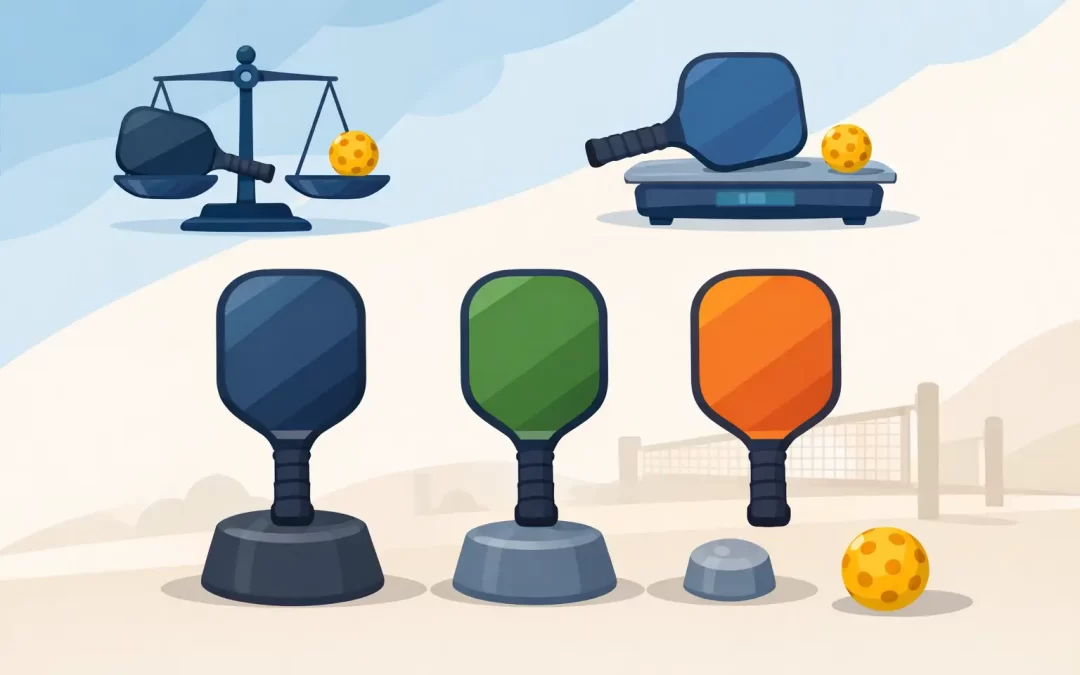
Most paddles fall into three useful categories. Lightweight paddles are generally under 7.5 ounces. Midweight paddles usually sit around 7.6 to 8.2 ounces. Heavy paddles are often 8.3 ounces and above.
A lightweight paddle usually appeals to players who value quick hands, fast counters, and less strain over long sessions. If you play a lot of dink-heavy points, rely on hand battles at the kitchen, or simply want a more maneuverable feel, lighter options make sense. The trade-off is that you may have to swing harder to generate pace, especially from the baseline or on full-speed drives.
Midweight paddles are the safe middle ground for a reason. They tend to offer the best blend of stability, touch, and enough mass to create depth without feeling sluggish. For many players, this range gives the easiest transition from rec play to more competitive play because it does not force you too far toward either extreme.
Heavier paddles reward players who like a firmer, more powerful response. If your game is built around drives, aggressive serves, and blocking hard shots without the paddle twisting in your hand, extra weight can help. The trade-off is reduced hand speed and potentially more stress on the wrist, elbow, or shoulder if your mechanics are late or inefficient.
Why balance matters as much as listed weight
This is where many buyers get tripped up. Total weight on a spec sheet tells part of the story. Balance tells you how that weight actually swings.
A head-heavy paddle can feel more powerful because more mass is working through contact, but it can also feel slower in quick exchanges. A more evenly balanced or handle-biased paddle often feels easier to maneuver, even if the overall weight is similar. That matters at the kitchen line, where fractions of a second decide whether you block cleanly or pop the ball up.
Players coming from tennis often understand this quickly. Swingweight changes how fast a frame moves through space and how stable it feels at contact. Pickleball is no different. If a paddle feels heavy only when you react late, balance may be the issue more than static weight.
How your playing style should guide paddle weight
If you are a control-first player, you probably care most about touch, resets, and consistency in the transition zone. A lighter or midweight paddle usually fits that profile well because it helps with feel and hand speed. You still want enough mass to keep the paddle stable, but not so much that soft hands become harder to maintain.
If you are an aggressive player who likes to speed the ball up, attack from midcourt, and drive through opponents, a midweight to slightly heavier paddle often gives better results. You get more plow-through on contact and less flutter when returning pace.
If you are an all-court player, midweight is usually the smartest starting point. It gives you room to shape your game without overcommitting to pure speed or pure power.
Doubles and singles can change the equation too. In doubles, hand speed and fast reactions matter more, especially at the kitchen. In singles, where you hit more full swings and need depth more often, a bit more weight can be useful.
Skill level changes what feels right
Beginners often assume lighter is easier. Sometimes it is, especially if they are worried about arm fatigue. But very light paddles can also feel unstable on mishits, and beginners tend to have more off-center contact. That instability can make control worse, not better.
For newer players, a midweight paddle is usually the most forgiving place to start. It gives enough mass for easy depth and enough maneuverability to learn soft game skills.
Intermediate players should think more specifically about where they win and lose points. If you are consistently late in hand battles, go lighter or look for a faster balance. If your blocks sit up short and your drives lack penetration, you may benefit from more mass.
Advanced players can be more intentional. At that level, the right weight supports a defined game style rather than general comfort alone. Stronger players with compact mechanics can often handle more weight without sacrificing speed. Others may prefer a quicker setup because their advantage comes from disguise, counters, and resets.
Comfort, injury history, and fatigue are part of performance
Competitive players sometimes ignore this part for too long. If your paddle helps for one game and hurts by game four, it is not the right setup.
A heavier paddle can reduce shock on some shots because it stays more stable through contact, but it can also increase fatigue over time. A lighter paddle may feel easier at first yet send more vibration or require more swing effort to create pace. This is why there is no universal best weight.
If you deal with elbow, wrist, or shoulder issues, stay honest about what your body tolerates. The best performance choice is the one you can repeat under match conditions. Equipment should support your mechanics, not ask your arm to compensate.
How to choose the right pickleball paddle weight in real life
Start with your current experience. Ask yourself three simple questions. Are you often late at the net? Do you struggle to create depth without overswinging? Does your arm feel fresh or taxed after extended play?
If you are late at the net, look lighter or more maneuverable. If you overswing for depth, look slightly heavier or more stable. If your arm gets tired, do not just go lighter automatically. Test whether the issue is total weight, balance, or an overly stiff feel.
The smartest move is to compare paddles across a narrow range instead of jumping from one extreme to the other. Even a shift of 0.2 to 0.4 ounces can be noticeable, especially when combined with a different balance profile. That is why experienced gear specialists pay attention to more than a single number.
Common mistakes players make with paddle weight
The biggest mistake is choosing weight based on one good swing in a short demo. Weight should be judged after serves, returns, drops, resets, and fast exchanges. A paddle that feels explosive on drives can still be too slow in hand battles.
Another mistake is copying a stronger or more advanced player. Their preferred weight may fit their timing, strength, and mechanics, but not yours. Equipment should define your style of play, not force you into someone else’s.
Players also underestimate adaptation time. A new weight may feel unusual for a session or two. But if the fit is correct, your timing should improve quickly, not get worse. If you still feel rushed, labored, or uncomfortable after several sessions, the setup is probably wrong.
The best starting point for most players
If you want the short answer from this pickleball paddle weight guide, start in the midweight range. It gives most players the best balance of power, control, stability, and comfort. From there, adjust based on what your game actually needs.
Go lighter if quick hands, touch, and reduced fatigue are your top priorities. Go heavier if you want more put-away power, stronger blocking, and better stability through contact. If you can, test with purpose rather than guessing. At Profilex, that equipment-first mindset is how serious players make smarter choices.
The right paddle weight should make your game feel simpler – cleaner contact, easier depth, quicker reactions, and more confidence when the point gets tight.