
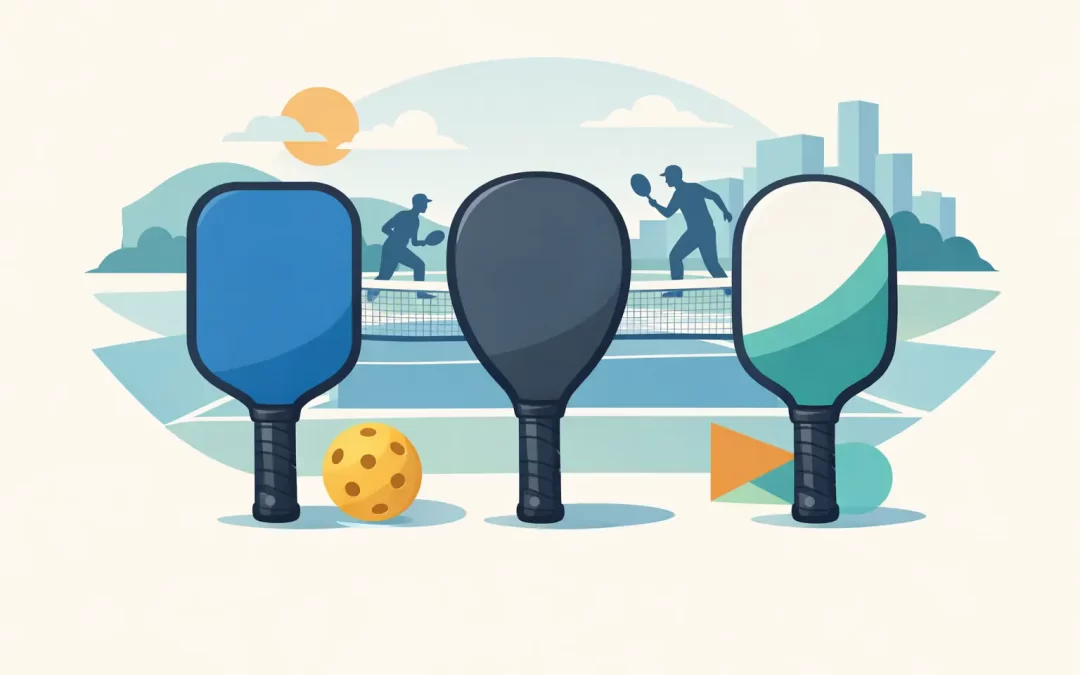
A paddle can feel perfect in a quick swing at the kitchen, then feel slow and unforgiving when you are defending a hard drive from the baseline. That difference often starts with shape. In this guide to pickleball paddle shapes compared, we break down what standard, elongated, hybrid, and widebody designs actually change on court – so you can choose equipment that supports your game instead of fighting it.
Shape is not a marketing detail. It influences reach, swing speed, sweet spot location, stability, and how confidently you can strike the ball when the point gets fast. The best choice depends on where you win points, where you miss, and how much forgiveness you need when contact is less than perfect.
Why Paddle Shape Changes Performance
Every pickleball paddle has a legal limit on its combined length and width, but manufacturers can distribute that surface area in very different ways. A longer paddle becomes narrower. A wider paddle becomes shorter. Hybrid profiles sit between those two extremes.
That geometry affects the paddle’s balance and its moment of inertia – its resistance to twisting or rotating at contact. You do not need a physics lesson to feel it. A wider face usually gives you a more stable, forgiving contact zone. A longer face gives you extra reach and leverage, but it can demand cleaner timing.
Core thickness, face material, weight, grip size, and balance point still matter. Two paddles with the same shape can play very differently. But shape is one of the fastest ways to narrow your options before comparing the finer details.
Pickleball Paddle Shapes Compared by On-Court Benefit
Standard shape: the balanced all-court option
A standard-shaped paddle typically has a face that is close to traditional proportions: moderately wide, moderately long, and built for reliable performance across the court. It is the safest starting point for newer players, recreational players, and competitors who do not want their equipment to favor one shot at the expense of another.
The biggest advantage is a generous, centrally located sweet spot. That helps on reset shots, fast hand battles, blocks, and off-center returns. When an opponent speeds the ball up at your body, a standard paddle is less likely to twist open in your hand than a narrow, elongated model.
Standard shapes are not limited to beginners. Many advanced players prefer them because they keep the paddle quick and stable at the kitchen line. If your game is based on dinking accurately, countering hard, and moving comfortably between defense and attack, this profile delivers the most balanced platform.
The trade-off is reach. You may give up a small amount of extension on wide balls and overheads compared with an elongated paddle. Players who rely heavily on two-handed backhands may also want more handle length than some standard models provide.
Widebody shape: maximum forgiveness and quick hands
Widebody paddles use a broader face and a shorter overall profile. They are designed to create a large, accessible hitting area and fast maneuverability in tight exchanges. For players still developing consistent contact, that extra width can make a noticeable difference immediately.
The wider face is especially useful on blocks and defensive resets. A ball that catches nearer the edge is more likely to stay playable, and the paddle often feels more planted against pace. This makes widebody designs a strong fit for players who play doubles frequently, face aggressive bangers, or simply want more confidence in rapid kitchen exchanges.
Because the paddle is shorter, it generally turns over quickly in the hand. That helps when you are reacting to body shots, switching between forehand and backhand counters, or defending a speed-up at close range.
The compromise is reduced reach and, in some cases, less leverage on serves and baseline drives. A widebody paddle can still produce pace, particularly with a high-quality face and a head-heavy balance, but its shape does not naturally extend through the ball the way a longer paddle can. Choose this profile when consistency and hand speed matter more than extracting every inch of court coverage.
Elongated shape: reach, leverage, and attacking upside
Elongated paddles stretch the face vertically while narrowing its width. They have become a popular choice among tournament-minded players because they offer more reach at the kitchen, more extension on passing shots, and a longer lever for serves, drives, and overheads.
That added length can be a genuine competitive advantage. On a wide dink, a stretched-out backhand volley, or an overhead that is just outside your normal strike zone, an elongated paddle can help you get to balls that a standard shape may miss. From the baseline, the longer profile can also encourage a more penetrating swing and stronger topspin drive.
Players who come from tennis often appreciate the familiar reach and attacking potential. If you use a two-handed backhand, look for an elongated model with an extended handle rather than assuming every long paddle will provide enough space for both hands.
The price of that reach is a narrower sweet spot. Miss toward the side of the face and the paddle can feel less stable than a standard or widebody design. Elongated models can also feel slower to maneuver at the kitchen, particularly when paired with a heavier weight or head-heavy balance. They reward clean mechanics and early preparation. For skilled players who want more offense without sacrificing touch, that is often a worthwhile trade.
Hybrid shape: the modern middle ground
Hybrid paddles are designed to combine the best parts of standard and elongated profiles. They are usually slightly longer and narrower than a traditional standard paddle, but not as extreme as a full elongated model. Many also use a more aerodynamic top section or a longer handle.
This category has grown because it meets the needs of the modern all-court player. You get more reach and potential leverage than a standard shape, while retaining more stability and forgiveness than a narrow elongated face. For players building a complete game – third-shot drops, drives, counterattacks, and fast hands – that balance can be ideal.
There is no single hybrid measurement. One brand’s hybrid may play close to standard, while another may feel almost fully elongated. Read the dimensions, not just the label. If possible, pay attention to face width, handle length, swing weight, and whether the paddle is balanced toward the head.
Hybrid designs are often the smart choice for intermediate players moving into more competitive play. They give you room to attack without making the paddle overly demanding on defensive contact.
How to Match Shape to Your Style of Play
Start with the shots that decide your points. If you are regularly late on fast exchanges or struggle to control hard volleys, a standard or widebody paddle is likely the better performance move. A larger, more stable hitting area will improve your margin for error before you chase added power.
If your opponents routinely pull you wide, you attack from the baseline, or you want extra length on your two-handed backhand and overheads, an elongated paddle deserves serious consideration. Make sure you can still react comfortably at the kitchen. Reach is valuable only if the paddle remains controllable under pressure.
For a player who wants one paddle to handle league doubles, practice sessions, and tournament play, hybrid shapes are hard to overlook. They offer an athletic blend of reach, stability, and maneuverability without pushing too far toward one specialty.
Your level also matters. Beginners often improve faster with standard or widebody forgiveness. Intermediate players should choose based on their strongest patterns and most frequent misses. Advanced players can be more specific: a counterpuncher may value stability, while an aggressive left-side player may prioritize reach and drive potential.
Do Not Judge Shape Without Weight and Balance
Paddle shape is only part of the fit. An elongated paddle with a low swing weight can still feel quick. A standard paddle with a heavy, head-loaded build can feel powerful but cumbersome. Likewise, a widebody paddle with a thin core may deliver fast pop, while a thick-core version may provide more control and dwell time.
Think of shape as the blueprint and weight distribution as the tuning. If you have elbow, wrist, or shoulder discomfort, avoid assuming that a longer or heavier paddle will automatically give you more power. Efficient contact, proper technique, and a comfortable swing weight usually produce better results than forcing a demanding setup.
Grip length deserves attention, too. Players using a two-handed backhand need enough handle real estate, while one-handed players may prefer a more compact handle that keeps the paddle maneuverable. The right shape should complement how you hold and swing the paddle.
Make the Choice on Court, Not on Paper
Dimensions tell you what a paddle is designed to do. Your response to a hard counter, a stretched dink, and a defensive reset tells you whether it is right for you. When comparing options, picture the rally you play most often and the shot you most want to improve.
Choose the face that gives you confidence to swing with purpose, absorb pace under pressure, and take the next ball early. At Profilex, that is the standard worth pursuing: smarter equipment choices that help you define your style of play and compete with conviction.