
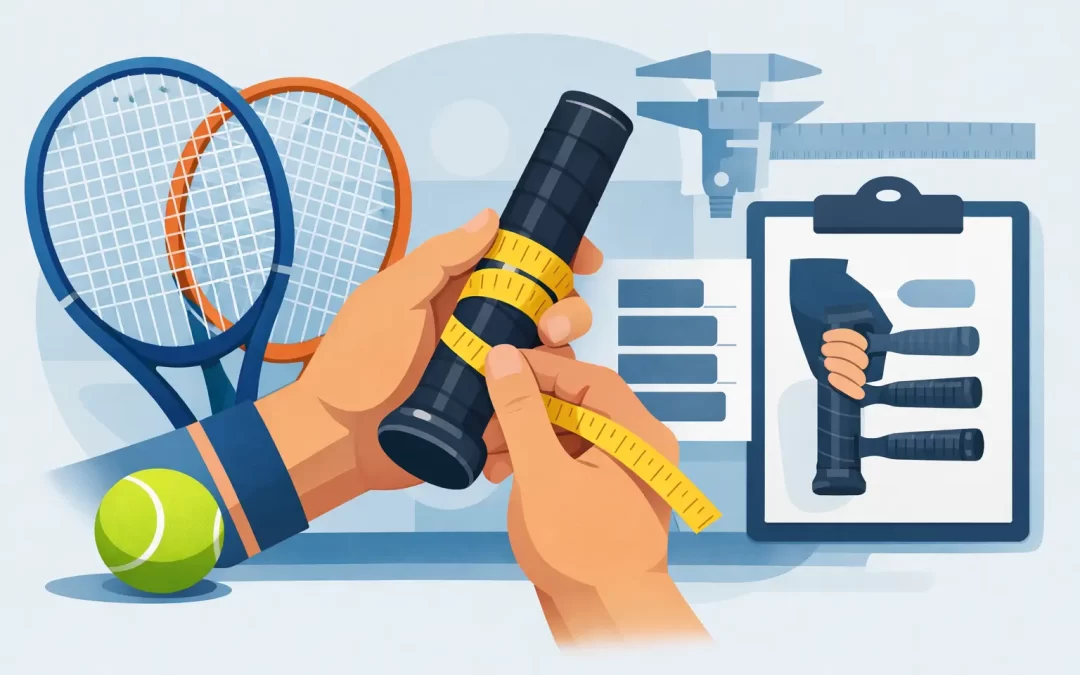
A racquet can have the right head size, string pattern, and weight on paper, then still feel wrong the moment you start hitting. Often, the issue is grip size. Knowing how to measure tennis grip size before you buy helps you build a more secure hold, swing with confidence, and avoid the arm fatigue that comes from fighting your handle on every ball.
Grip sizing is not a minor detail reserved for advanced players. It affects how freely your wrist moves, how confidently you accelerate through contact, and how well you manage racquet face control on serves, returns, and heavy topspin exchanges. For juniors moving into adult racquets, league players replacing a favorite frame, and competitors dialing in a new setup, getting this decision right is worth a few careful minutes.
Why Tennis Grip Size Changes Your Performance
A grip that is too small can make the racquet twist in your hand. Players often respond by squeezing harder, which can create unnecessary tension in the hand, forearm, and elbow. That extra squeeze may feel secure at first, but it makes relaxed acceleration harder and can reduce feel on touch shots, slices, and volleys.
A grip that is too large creates a different problem. It limits finger wrap and can make grip changes slower, especially when moving from a forehand to a backhand or reacting at the net. Players with oversized handles may feel late on fast exchanges or struggle to generate the wrist action they want on serves and topspin groundstrokes.
The best size gives you a stable connection to the racquet without forcing your hand to work overtime. You should be able to hold the frame firmly through contact, then relax between shots. That balance supports control, comfort, and racquet-head speed.
How to Measure Tennis Grip Size at Home
The two methods below provide a reliable starting point. Use both when possible. A measurement tells you where to begin, while the racquet-in-hand check confirms whether that size actually suits your hand and playing style.
Use the ruler method
Open your dominant hand with your fingers straight and close together. Find the lower horizontal crease in your palm, typically the prominent line crossing the middle of the hand. Place a ruler at the tip of your ring finger and measure straight down to that crease.
That measurement in inches is your approximate grip size. If you measure close to 4 3/8 inches, for example, start with a 4 3/8 grip. Most adult tennis racquets are offered in 1/8-inch increments, so you do not need to chase an impossibly exact number.
Common US grip sizes are 4 1/8, 4 1/4, 4 3/8, 4 1/2, 4 5/8, and 4 3/4 inches. You may also see them labeled from 1 through 6:
- Grip 1: 4 1/8 inches
- Grip 2: 4 1/4 inches
- Grip 3: 4 3/8 inches
- Grip 4: 4 1/2 inches
- Grip 5: 4 5/8 inches
- Grip 6: 4 3/4 inches
Grip 2 and Grip 3 are common adult sizes, but do not select based on what is popular. Hand dimensions vary widely, and a player with smaller hands may perform far better with a smaller handle even when using a heavier, more advanced racquet.
Use the index-finger test
If you can hold a racquet in person, take an Eastern forehand grip. The base knuckle of your index finger should rest on the third bevel of the handle. Then slide the index finger of your non-hitting hand into the space between your fingertips and palm.
If your finger fits snugly in that gap, the grip is generally in the right range. If there is no room for the finger, the handle is likely too small. If there is a large amount of space, the grip is likely too big.
This test is especially useful when you are between sizes. It accounts for how your fingers wrap around a particular handle shape, not just the length of your hand. Keep in mind that grip shapes vary by brand. A racquet with a more rectangular handle can feel different from a similarly sized racquet with a rounder profile.
What to Do If You Are Between Grip Sizes
When the choice is close, start smaller rather than larger. You can increase a grip size with an overgrip, a thicker replacement grip, or a heat-shrink sleeve. Reducing an oversized handle is far more difficult and may alter the racquet’s shape or feel.
An overgrip usually adds roughly one-sixteenth of an inch, depending on its thickness and how tightly it is wrapped. That small change matters. A player whose bare 4 1/4 handle feels slightly undersized may find that the same racquet with a comfortable overgrip becomes the ideal fit.
A heat-shrink sleeve is a more permanent adjustment and generally increases the handle by a full grip size. It also adds weight in the handle, which can make the racquet more head-light. That may be a positive for some players, but it is a real equipment change, not just a comfort upgrade.
Players who prefer a thinner, more connected feel often choose the smaller option and use a thin overgrip. Players who need more cushioning or who deal with sweaty hands may prefer a slightly larger base grip paired with a tacky or absorbent overgrip. There is no one-size-fits-all answer because hand size, grip pressure, and preferred feel all matter.
Signs Your Current Grip Is Wrong
Your body and your ball flight can reveal a grip issue before a ruler does. A handle that slips or rotates on heavy shots may be too small, though worn-out grips and perspiration can cause the same symptom. Replace old grips before deciding you need a new racquet size.
Persistent hand fatigue, a tendency to over-squeeze, or discomfort around the forearm can also point to a handle that is too small. On the other side, if you feel disconnected from the racquet face, slow during grip changes, or unable to comfortably wrap your fingers around the handle, the grip may be too large.
Do not diagnose every elbow or wrist issue as a grip-size problem. String stiffness, racquet weight, balance, swingweight, technique, and training volume also affect comfort. But grip size is one of the simplest variables to check, and it should be part of any serious equipment evaluation.
Grip Size for Juniors and Growing Players
Parents buying for competitive juniors face a familiar temptation: purchase a larger grip so the racquet lasts longer. Avoid making a major jump for growth. A grip that is too big can interfere with proper stroke development and force a young player to compensate with excessive hand tension.
Choose the size that fits now, or only slightly larger if the player is truly on the edge between two sizes. An overgrip offers a practical way to fine-tune the handle as hands grow. It also protects the original replacement grip and gives juniors a fresh, confident feel during long practices and matches.
For younger players transitioning from junior frames to adult racquets, grip size should be evaluated alongside racquet length, weight, and swingweight. The goal is not simply to move into an adult frame. The goal is to move into a setup they can swing fast, control under pressure, and use without straining.
Do Overgrips Change the Measurement?
Yes. The listed grip size refers to the handle before an overgrip is added. Since most players use an overgrip, the finished grip will feel larger than the number printed on the racquet butt cap.
This is why testing a friend’s racquet can sometimes be misleading. A 4 3/8 racquet with a thick replacement grip and a heavily wrapped overgrip may feel closer to a larger size than its label suggests. If you are comparing racquets, pay attention to the full setup: base grip, replacement grip condition, and overgrip thickness.
For a clean comparison, hold a new or recently regripped racquet in your normal playing grip. Make a few shadow swings, practice your forehand-to-backhand transition, and simulate a serve. The right handle should feel secure without demanding a death grip.
Build Your Racquet Around a Grip You Trust
Grip size is the foundation of the player-racquet connection. Once it is right, you can make better decisions about strings, tension, balance, and overgrip choice because you are evaluating the racquet from a stable starting point. At Profilex, that equipment-first approach matters: performance gains come from matching every part of the setup to the player holding it.
Measure your hand, confirm the fit with a racquet when possible, and give yourself room to fine-tune with an overgrip. The right grip will not hit the ball for you, but it can help every swing feel more natural, more controlled, and ready for the next point.