
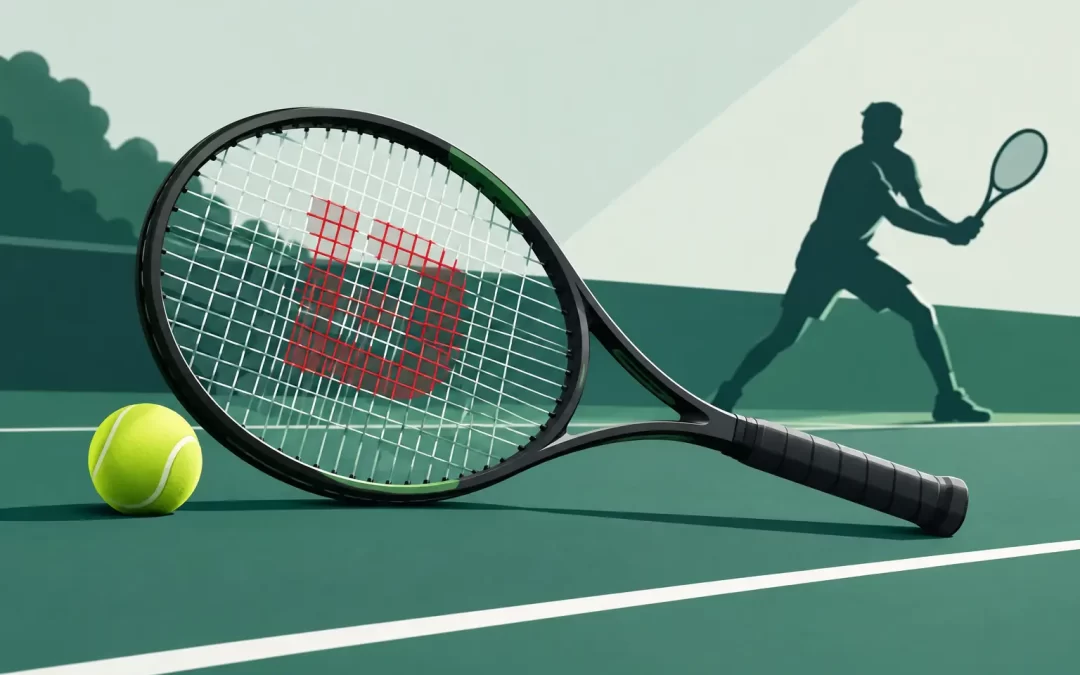
A racquet can feel great during easy warmup balls and still disappear when the score reaches 4-4 in a third set. This Wilson Blade review focuses on what matters under pressure: predictable launch, directional confidence, stability against pace, and enough feel to trust a full swing. The Blade has earned its place with aggressive baseliners and all-court competitors because it rewards players who create their own racquet-head speed instead of asking the frame to do all the work.
Wilson Blade Review: The On-Court Identity
The Wilson Blade is a control-oriented performance racquet family built for players who want to attack with precision. Its response is more connected and deliberate than a typical power frame. When you take a committed cut at the ball, the Blade helps you drive through your target, shape a heavy crosscourt ball, or flatten out a backhand down the line without feeling as if the ball is launching unpredictably.
That does not mean the Blade is underpowered. It means the power is player-generated. A technically sound player who loads the legs, accelerates through contact, and swings with purpose can produce serious pace. The difference is that the frame keeps that pace organized. You are less likely to feel that the racquet is adding extra trampoline effect when you are already swinging big.
The Blade’s signature strength is its blend of control and feel. Contact tends to feel plush compared with many stiff, modern power racquets, but the racquet remains firm enough at impact to deliver a clean, stable response. Players who use spin as a way to control pace will appreciate the ability to brush up on the ball while still feeling connected to the string bed.
The trade-off is straightforward. Players with short, compact strokes or limited acceleration may find the Blade demanding, especially in its heavier 98-square-inch versions. If you want easy depth from defensive positions, a more powerful frame may be a better fit. The Blade is at its best when you are stepping in, swinging freely, and taking ownership of the point.
Who Should Play With a Wilson Blade?
The Blade is a strong match for intermediate-to-advanced players, competitive juniors, college-bound athletes, and adult league players who value placement over free power. It suits a modern baseline game particularly well, but it is not limited to baseline specialists. The controlled response gives confident net players the touch needed for sharp angles, controlled punch volleys, and low, skidding approach shots.
If your current racquet launches the ball too high or makes it difficult to rein in aggressive swings, the Blade deserves serious consideration. It can also be a smart move for a player progressing out of an oversized or very light frame and ready for more stability and precision.
It is less ideal for beginners who need help creating depth. It may also be the wrong choice for players who prefer a very crisp, explosive impact sensation. The Blade’s feel is more refined than lively. Some players love that pocketing sensation immediately; others will prefer a firmer, faster response.
Baseline players who dictate with shape
The Blade 98 16×19 is often the most natural starting point for the modern aggressive player. Its more open pattern provides accessible spin and a little more launch than the denser version, which helps when rolling heavy forehands above the net or defending with height. It gives strong hitters room to swing without making the racquet feel uncontrollable.
For the player who attacks with flatter drives, redirects pace, and wants the ball to stay on a tighter trajectory, the Blade 98 18×20 brings a more disciplined response. The denser pattern generally offers a lower launch angle and a more compact, precise feel. It asks for clean preparation and full acceleration, but it can be outstanding for players who strike the center of the string bed consistently.
All-court competitors and developing players
The Blade 100 offers a more forgiving route into the family. The larger head size expands the effective hitting area, adds a touch of easy depth, and makes the racquet more manageable on stretched defensive shots. It remains control-focused, but it does not demand quite as much precision as a 98.
Lighter Blade options can make sense for developing juniors, players returning from injury, or adults who want the Blade feel without the workload of a heavier frame. Be realistic here: a lighter racquet is easier to accelerate, but it can be pushed around by a heavy ball. The right specification is the one you can swing with speed for two hours while maintaining form on serve and late-match defense.
Feel, Stability, and Maneuverability
The Blade’s feel is a major reason it has stayed relevant across multiple generations. It provides enough feedback to tell a player where contact happened without transmitting every vibration into the hand. On well-struck balls, the sensation is controlled and solid rather than harsh.
At net, that feedback helps with touch. Drop volleys, short angles, and low pickups require more than a large sweet spot. They require a frame that does not feel disconnected from the ball. The Blade gives skilled hands useful information at contact, while its stable construction supports firmer volleys against hard passing shots.
Maneuverability depends heavily on the model and your string setup. The 98-inch versions are quick enough for aggressive returns and fast exchanges, but they are not ultralight, quick-whip racquets. Their stability comes with some mass. That is a positive for players who want to absorb pace, but a player with slower preparation should not assume that more weight automatically means better performance.
On serve, the Blade rewards rhythm. Players who can accelerate through the motion will find good directional control on flat serves and plenty of bite on kick serves. Those searching for effortless mph may want a more power-oriented racquet. The Blade will not manufacture speed, but it gives the confident server a reliable platform for hitting spots.
Choosing Between Blade 98 16×19, 18×20, and 100
The choice should begin with your ball flight, not what another player uses. Choose the Blade 98 16×19 if you want the most versatile blend of spin, control, and attacking potential. It is the best fit for the player who swings fast, uses topspin naturally, and wants margin without sacrificing the ability to finish points.
Choose the Blade 98 18×20 if your game is built around precision, flatter drives, and taking the ball early. It is a specialist’s option in the best sense: demanding, composed, and highly rewarding when matched to clean mechanics.
Choose the Blade 100 if you want more forgiveness, a little more accessible depth, and an easier transition from a larger or more powerful racquet. For many strong recreational players, the 100 is the practical sweet spot. It preserves the Blade’s controlled personality while making difficult balls more playable.
Demoing remains the best answer whenever possible. Hit serves, returns, defensive slices, and high forehands – not just comfortable rally balls. A racquet has to work when your feet are late and your opponent is taking time away.
Strings Can Make or Break the Blade
String selection changes the Blade more dramatically than many players expect. A control frame paired with a dead, overly firm polyester can feel demanding and low-powered, particularly for players who do not generate elite racquet-head speed. On the other hand, a powerful multifilament at high tension can reduce the precise response that draws players to the Blade in the first place.
For frequent competitors with long, fast swings, a shaped or smooth co-polyester at a sensible tension can produce excellent spin and predictable control. Start in the middle of the recommended tension range rather than pulling too tight. Lowering tension modestly can add pocketing, comfort, and easier depth without turning the Blade into a launchy racquet.
Players prioritizing arm comfort, or those who do not break strings often, should consider a softer co-polyester, a multifilament, or a hybrid. A poly main with a softer cross can retain control while giving the string bed more feel and liveliness. This is where advice from an experienced racquet technician matters: the right string and tension should support your swing, not force you to compensate for your equipment.
The Verdict for Serious Players
The Wilson Blade remains one of the strongest racquet choices for players who want their technique to show up on the ball. It is not a shortcut to easy power, and that is exactly why committed players keep coming back to it. The frame gives you the control to swing bigger, the feel to create with confidence, and the stability to stand up to modern pace.
Choose your head size and pattern honestly, then give the string setup the same attention you give the racquet itself. When the Blade is matched correctly, it does not just help you hit a better ball – it gives you more confidence to play the ball that changes the point.