
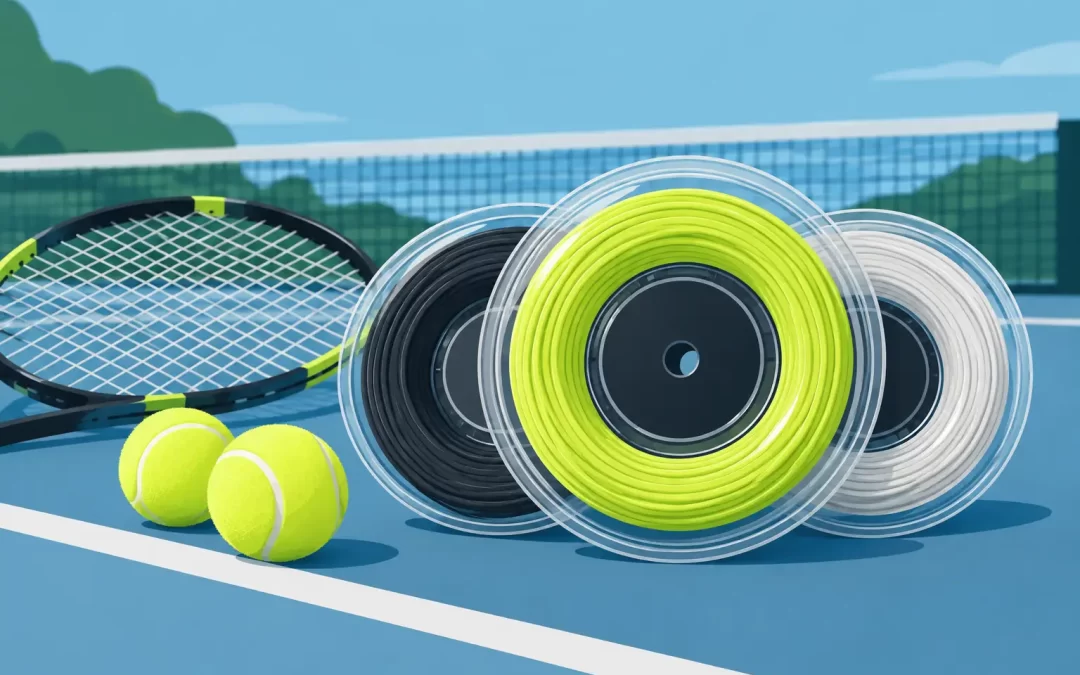
A reel is not just a bigger spool of string. For players who restring regularly, coaches managing junior programs, and racquet technicians serving a club, the right reel determines how consistently a racquet performs over an entire season. The top tennis string reels combine reliable playability with the durability and value needed to keep racquets in rotation.
A single set can tell you whether a string feels good for two hours. A reel tells you whether that string belongs in your long-term setup. That difference matters when you are chasing heavier spin, a more predictable launch angle, better arm comfort, or lower cost per restring.
What Makes a Tennis String Reel Worth Buying?
The best reel for one player can be the wrong choice for another. Polyester has become the standard for modern, aggressive swings because it resists movement and helps players swing fast with confidence. But not every co-poly plays the same. Some feel crisp and controlled, some are shaped for maximum bite, and others are built to be more forgiving at impact.
Start with your stroke speed and the result you want from your string bed. Big hitters who break strings or create heavy topspin generally benefit from durable polyester reels. All-court players may want a smoother co-poly that offers cleaner response and easier snapback. Players managing elbow or shoulder sensitivity should avoid assuming that every durable poly is suitable at high tension. A softer co-poly, lower reference tension, or hybrid can make a major difference.
Value also goes beyond the reel price. Most 660-foot reels produce roughly 16 to 18 full string jobs, depending on head size, pattern, and whether you are stringing one-piece or two-piece. Divide the reel cost by the number of jobs you realistically expect to get from it, then compare that number with the price of individual sets. If you restring often, the savings can be substantial.
Top Tennis String Reels by Playing Style
Luxilon ALU Power: Precision for Fast, Advanced Swings
Luxilon ALU Power remains a benchmark for players who want a crisp, connected response and exceptional control during aggressive ball striking. It is a strong option for advanced competitors who generate their own pace and want the ball to come off the strings with a predictable, precise feel.
The trade-off is familiar to experienced players: ALU Power is premium-priced and can feel firm, especially as it ages. It is best for players who restring frequently enough to enjoy its best performance window rather than trying to extend it for too many hours. If clean contact, directional control, and a professional-style response are your priorities, it remains one of the most proven reel choices available.
Solinco Hyper-G: Spin and Control for Modern Baseliners
Solinco Hyper-G is a favorite among competitive juniors, high-level club players, and heavy topspin baseliners for good reason. Its shaped profile grips the ball well, while its firm co-poly construction keeps the string bed controlled when swing speed rises.
Hyper-G rewards full cuts at the ball. Players who use topspin to push opponents behind the baseline often appreciate its confidence under pressure, particularly on groundstrokes and kick serves. It is not the softest poly on the market, so tension selection matters. Starting a few pounds lower than your previous synthetic gut setup is often smarter than stringing it at the same number.
Babolat RPM Blast: Heavy Rotation and a Firm Response
Babolat RPM Blast is built for players who want a firm, spin-oriented polyester with a highly recognizable response. Its octagonal shape supports aggressive ball rotation, and its controlled feel suits players who attack from the baseline but still want enough confidence to flatten out a forehand when the court opens up.
This is a strong reel for tournament players who know they prefer a firmer string bed. It can be demanding for players with compact swings or arm discomfort, especially at higher tensions. In the right racquet and tension range, however, RPM Blast gives aggressive players the bite and control to swing without holding back.
Yonex Poly Tour Pro: A More Comfortable Co-Poly Option
Not every player needs the sharpest-shaped or stiffest polyester. Yonex Poly Tour Pro offers a smoother, more comfortable co-poly feel that suits all-court players and competitors who want control without an overly harsh response.
Its round profile provides consistent snapback and a cleaner feel at contact than many aggressively shaped strings. That makes it a smart choice for players who hit with spin but do not want every ball to launch with an extremely high trajectory. It also works well in a hybrid, paired with a softer cross string for added touch and comfort.
Tecnifibre Razor Code: Controlled Feel for All-Court Competitors
Tecnifibre Razor Code is aimed at players who value a crisp, stable response and dependable control across a complete game. It is particularly appealing for competitors who mix heavy groundstrokes with flatter drives, approach shots, and net play.
Compared with more aggressively shaped options, Razor Code is less about exaggerated bite and more about precision. That can be an advantage for players whose technique already creates sufficient spin and who want their string to keep the ball from sailing long under pressure. It is a serious option for players who want a professional, controlled response without choosing a string based solely on shape.
Profilex Performance Co-Poly: Smart Value for Frequent Restringing
For players, coaches, and stringers looking to control their cost per job without giving up a performance-focused polyester setup, Profilex Performance Co-Poly is worth considering. A reel makes particular sense when you are maintaining several racquets, stringing for a junior household, or replacing polyester before it goes dead rather than waiting for it to break.
The key is matching the string to your game instead of buying a reel only because it is economical. A value reel that encourages timely restringing can outperform an expensive string that stays in a racquet long after its response has faded.
Gauge Changes More Than Durability
Choosing between 16 gauge, 17 gauge, and thinner options is one of the most important decisions when buying a reel. Thicker string generally lasts longer and feels more stable, making it practical for frequent breakers and players using open-pattern racquets. Thinner string usually offers more feel, spin potential, and liveliness, but it will wear faster.
For many competitive adult players, 16L gauge is the middle ground. It supplies more durability than a thin 17 gauge while preserving more feel than a full 16 gauge. Junior competitors who break strings often may be better served by 16 gauge, while touch-oriented players with dense string patterns can benefit from 17 gauge.
Do not treat gauge as a minor detail. A player who loves a string in 17 gauge may find the 16 gauge version too firm or too muted. If possible, test one set in your preferred gauge before committing to a reel.
How to Get Better Results From Your Reel
A reel gives you the freedom to tune your setup, and that is where real performance gains happen. Keep notes after each restring: string type, gauge, tension, racquet, playing hours, and how the string felt in matches. You will quickly see patterns that are easy to miss when you change multiple variables at once.
If your shots are flying long, do not automatically jump to a stiffer string. Consider whether your current poly has lost tension, whether the racquet is too powerful for your swing, or whether a small tension increase would solve the issue. If your arm feels beat up, lowering tension by two to four pounds or using a softer co-poly may be more effective than abandoning polyester entirely.
Hybrid setups are another smart way to use a reel. Pairing a durable poly main with a softer cross can provide more comfort and feel, while using a smooth poly cross can help a softer main string slide and snap back. There is no single correct hybrid, but the right combination can deliver a better balance than a full bed.
Choose a Reel That Matches Your Season
The best tennis string reel is the one you will use often enough to keep your racquets performing at their best. A hard-hitting baseliner may need a shaped, durable co-poly. A doubles player may prefer a smoother string with more touch. A competitive junior may need the cost control of a reel and a dependable stringing schedule more than the newest string trend.
Choose based on your actual swing, your racquet pattern, and how often you can restring. When your strings are selected with the same purpose as your racquet and training, every ball feels more predictable – and that is the confidence serious players carry onto the court.