
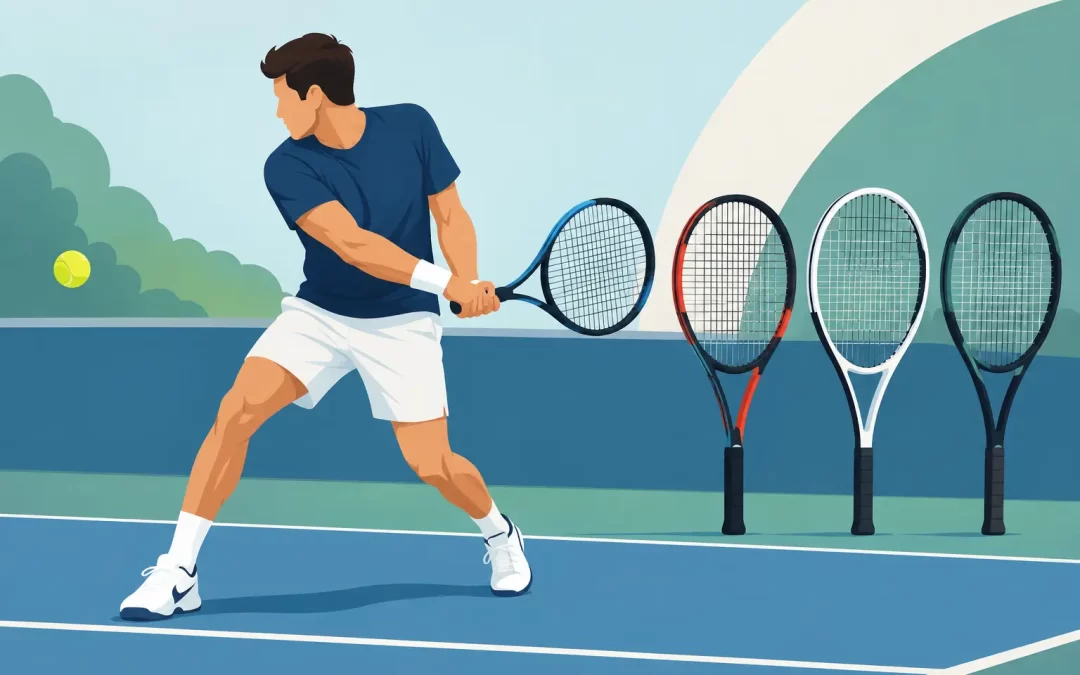
A one-handed backhand tells the truth about a racquet fast. If the frame twists at contact, feels slow through the hitting zone, or launches the ball unpredictably, there is nowhere to hide. The best tennis racquets for onehanded backhand players deliver a connected, stable response that lets you drive through the ball, knife a slice, and take the ball early with confidence.
This does not automatically mean you need the heaviest racquet on the market. It means you need a frame whose weight, balance, head size, flex, and string setup match the way you create pace. A smart fit turns a demanding stroke into a dependable weapon.
What a One-Handed Backhand Needs From a Racquet
The one-handed backhand has less structural support than a two-hander. Your arm, shoulder, grip, and timing must keep the racquet face stable through impact. That is why many strong one-handed players prefer racquets with a more substantial feel than the average lightweight, oversized frame.
Stability is the first priority. A racquet that holds its line against a heavy incoming ball helps you return serve and redirect pace without the head fluttering open. Static weight matters, but swingweight often matters more. Swingweight describes how heavy the racquet feels when you swing it. A frame can be manageable on the scale yet still carry enough mass through contact to produce a penetrating backhand.
Control comes next. One-handers often hit a flatter, more linear drive than players who use two hands, particularly when stepping inside the court. A predictable stringbed and controlled launch angle make it easier to commit to that forward swing. Dense patterns and smaller heads commonly provide that direct response, although they are not mandatory for every player.
Feel also deserves a real place in the decision. The best one-handed backhands rely on precise contact. A racquet with good feedback helps you sense the ball on the strings, adjust the face on a short-hop, and disguise a slice. A muted modern frame can still work, but players who value touch may prefer a thinner beam or more flexible construction.
The Specs That Matter Most
Weight and swingweight
For many adult players, a strung weight around 11.3 to 12.2 ounces offers a productive range. Competitive players with sound mechanics may benefit from a frame at the upper end of that range, especially against pace. The added mass can make the racquet more stable and help the ball leave with greater depth.
There is a trade-off. Too much racquet can make late contact more common, particularly on high backhands or quick returns. If your backhand breaks down late in long matches, a lower swingweight or a slightly more head-light balance may improve your results more than extra mass.
Head size and sweet spot
A 97 to 100 square-inch head is the sweet spot for many one-handed players. A 97 or 98 typically provides a compact, precise response for players who strike the center consistently. A 100 adds forgiveness and easier access to depth, which can be valuable for club competitors, juniors moving into adult frames, and anyone facing heavy topspin.
Do not assume a smaller head automatically gives better control. If a 97 leaves you tense because you are missing the sweet spot, a stable 100-inch racquet may produce a more controlled ball in real match play.
Balance and maneuverability
A head-light balance is a classic fit for the one-handed backhand. It helps the racquet move quickly from a neutral position, supports last-second adjustments, and keeps the frame mobile for slices and volleys. This is particularly useful if you play all-court tennis rather than camping behind the baseline.
That said, balance cannot be judged alone. A very head-light racquet with insufficient swingweight may feel quick but get pushed around. The goal is maneuverable stability: enough mass in the hitting zone to stay firm, without a sluggish feel on reaction shots.
Flex and beam design
Flexible, thinner-beam frames are popular with one-handed players because they often provide touch and directional control. They can make a carved slice feel crisp and a driven backhand feel connected. The compromise is that they may demand more from your swing to create easy depth.
Stiffer, thicker-beam racquets can offer more free power and a larger, livelier response. They suit players who need help getting the ball through the court, but they can feel less precise and may be less comfortable for players with arm sensitivity. Your string selection has a major effect here.
Four Racquets Worth Considering
The right model depends on your level, physical strength, and preferred ball shape. These four frames represent different paths to a stronger one-handed backhand.
Wilson Pro Staff 97
The Pro Staff 97 remains a natural choice for players who want classic control, solid impact, and a head-light feel. Its compact head rewards clean technique and supports a direct, attacking backhand. Players who like to drive down the line, return aggressively, and use feel at net will appreciate its connected response.
It is not the easiest racquet for producing depth when you are late or off balance. This is a performance frame for players willing to bring racquet-head speed and repeatable mechanics.
Head Prestige MP
The Head Prestige MP is built for players who put placement and feel ahead of easy power. Its controlled response encourages full swings, while its stable construction helps the racquet stay composed through a one-handed drive. The Prestige family has long appealed to advanced ball strikers for good reason: it rewards intent.
Choose this type of frame if you already generate your own pace and want a racquet that lets you hit smaller targets. Players seeking a more forgiving response on defensive shots may prefer a 100-inch alternative.
Yonex Percept 97
The Yonex Percept 97 offers a controlled, feel-oriented option with a distinctive head shape that can create a generous effective hitting area. For one-handed players, that can be a meaningful advantage on the contact point that is just outside perfect. It has the precision to flatten out a backhand but enough forgiveness to remain practical for serious club and tournament players.
Its lower-powered character favors players who accelerate confidently. Pair it with an appropriate string and tension, and it can produce outstanding trajectory control.
Babolat Pure Strike 98
The Babolat Pure Strike 98 is a strong option for the modern aggressive player who wants more speed and pop than a traditional players’ frame typically offers. It gives a crisp, fast response for taking the ball early and changing direction, while still delivering the precision needed for a committed one-hander.
Compared with a softer control frame, it may feel firmer at impact. Players who are sensitive to stiffness should pay close attention to string choice and tension rather than assuming the racquet alone determines comfort.
String Setup Can Make or Break the Fit
A racquet is only half the system. The wrong string can make an excellent frame feel boardy, unstable, or unpredictable.
A controlled co-polyester is often a strong match for advanced one-handed players because it limits excessive launch and supports fast, confident swings. Profilex Performance Co-Poly strings can be a useful option for players who want durable control without giving up a responsive feel. Start at a sensible tension rather than pulling polyester too tight. Many players find that a moderate tension gives the strings enough movement and pocketing to improve both comfort and depth.
If your backhand feels harsh, short, or difficult to accelerate, consider a hybrid with natural gut or a quality multifilament in the mains and a smooth polyester in the crosses. The added pocketing can help your slice stay low and make full backhand drives feel less demanding. Players with arm pain should prioritize comfort first and consult a qualified professional if symptoms persist.
Test the Backhand You Actually Hit in Matches
A quick warm-up is not enough to evaluate a racquet. During a demo, hit crosscourt drives, down-the-line changes, defensive slices, high balls above shoulder level, and backhand returns. Those are the shots that reveal whether the frame helps your game or simply feels good for ten minutes.
Pay special attention to your contact quality late in the session. If the racquet remains stable when your legs are tired and your timing is less perfect, it is probably a better match than a heavier frame that only shines when you are fresh. Also test your slice. A great one-handed racquet should let you carve a low, skidding ball without feeling cumbersome.
The right racquet will not replace footwork or preparation, but it should make your best technique easier to repeat under pressure. Choose the frame that gives your backhand a clear purpose: drive through the court, defend with a reliable slice, and step up to the line when the match asks for it.