
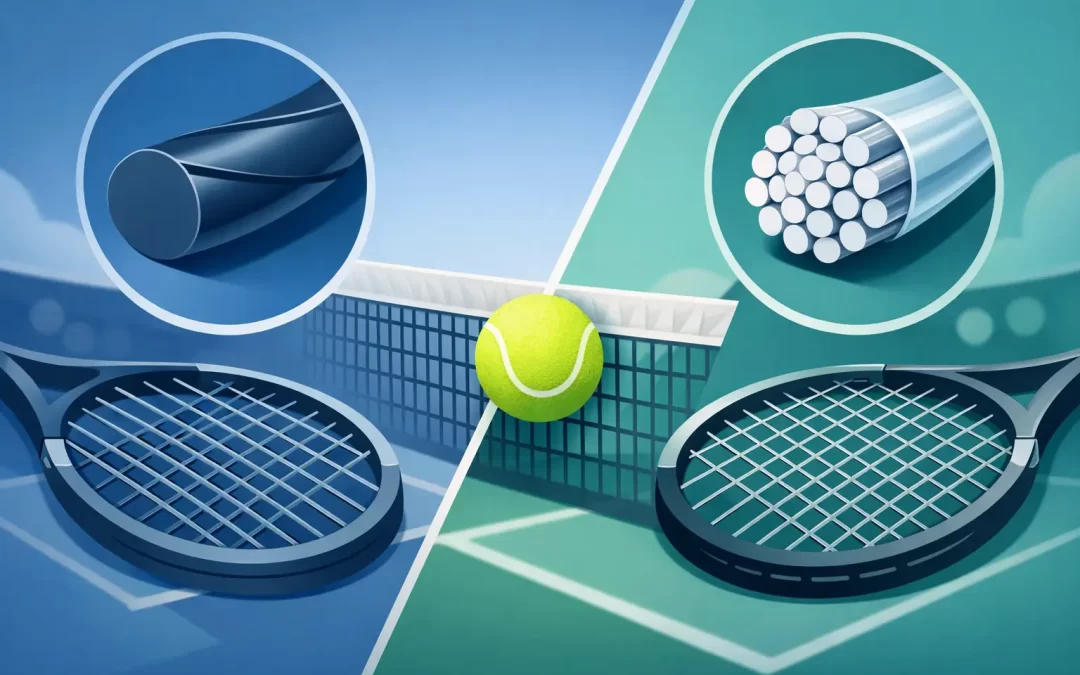
One bad string choice can make a solid racquet feel completely wrong. If you’re comparing poly vs multifilament tennis strings, you’re really deciding how you want the ball to leave the string bed – firmer and more controlled, or livelier and more forgiving.
That choice matters more than most players realize. Strings are the engine of your racquet’s response, and they shape spin, launch angle, comfort, feel, and tension maintenance more than a cosmetic racquet update ever will. The right setup helps you swing with confidence. The wrong one makes you second-guess every ball.
Poly vs multifilament tennis strings: the core difference
Polyester strings, usually called poly, are built for control, durability, and spin potential. They are typically firmer, lower powered, and more resistant to movement than softer string types. Modern co-polys have improved feel compared with older polyester strings, but the category still leans toward a crisp, controlled response that rewards fast swings.
Multifilament strings are made from thousands of microfibers designed to mimic some of the comfort and pocketing of natural gut. They are softer, more powerful, and easier on the arm. They also tend to feel more elastic at impact, which many recreational players and doubles players prefer right away.
If you want the quick version, poly usually fits players who generate their own pace and want to swing aggressively without overhitting. Multifilament usually fits players who want easier depth, more comfort, and a more forgiving response on off-center contact.
What poly does best
Poly has become the default choice for many competitive players because the modern game rewards racquet-head speed. When you swing hard, poly helps keep the ball trajectory in check. You get a deader response than multifilament, which means you can take a full cut and trust the string bed not to launch the ball long as easily.
Spin is another major reason players switch to poly. It is not magic on its own, but it supports spin-heavy mechanics well. The string’s lower power and snapback behavior can help aggressive baseliners create heavier topspin and more shape on the ball. For players who attack with modern forehands and heavy serves, that matters.
Durability is also a big selling point. Frequent string breakers often get much more life out of poly than multifilament. If you are a junior tournament player, a hard hitter, or someone who strings through softer constructions quickly, poly can be the more practical option.
The trade-off is feel and comfort. Poly is firmer and generally less arm-friendly, especially at higher tensions or in full beds for players who do not swing fast enough to make the string work.
Where multifilament wins
Multifilament makes tennis feel easier. It gives you more free power, better shock absorption, and a softer response on contact. If your current setup feels harsh, boardy, or dead, a multifilament can change the entire feel of the racquet without changing the frame.
Comfort is the headline benefit. Players dealing with tennis elbow, shoulder soreness, wrist sensitivity, or general arm fatigue often do better with multifilament than with full poly. The string bed deforms more at impact, which helps reduce shock and can make longer sessions more manageable.
Multifilament also helps players who need more depth without swinging out of their shoes. That includes many club players, doubles specialists, improving juniors, and adults returning to the game. If your balls land short unless you force the issue, a multifilament setup can add useful pop.
Touch players tend to like it too. Volleys, slices, and short-angle shots often feel more connected with multifilament because of its softer pocketing. It gives a more traditional, responsive sensation that many all-court players still value.
The downside is durability and control. Multifilament can fray, notch, and break faster, especially for topspin players. It can also get too lively for players with big swings.
Control vs power is only part of the story
A lot of players frame this as simple power versus control, but that is only half right. The better question is how you create pace.
If you already generate racquet-head speed and compress the ball cleanly, extra power is often not what you need. You need predictability. Poly gives you that firmer, lower-powered platform so you can accelerate confidently.
If your swing is more compact or your contact is less consistent, control from a dead string bed may not actually help. You may lose depth, press too hard, and spray more balls because you are forcing pace. In that case, multifilament can improve control in a practical sense by giving you easier length and better feel.
That is why the best string for a 4.5 baseline player is not automatically the best string for a 3.0 doubles player, even if both say they want more control.
Who should use poly
Poly is usually the right call for competitive players with full swings, frequent topspin, and a clear need for durability. It fits hard hitters who break strings, juniors training multiple days a week, and baseliners who want to attack with confidence from the back court.
It also makes sense for players using powerful modern racquets who need to tame the launch and firm up the response. A shaped or slick co-poly can sharpen spin production and help a powerful frame feel more disciplined.
That said, poly is not ideal just because it is popular. If you are a lower-volume hitter, an older player with arm sensitivity, or someone who rarely breaks strings, full poly may give you less benefit than you expect. A lot of club players use poly because advanced players do, then wonder why their racquet feels harsh and underpowered.
Who should use multifilament
Multifilament is a strong fit for players who want comfort first, but it is not only for injured players. It works well for all-around players, doubles players, flatter ball strikers, and anyone who values easy pace and touch.
It is also a smart option for juniors not ready for full poly, adults coming back to tennis, and players who simply do not swing fast enough to get the best out of polyester. If you want your racquet to feel more alive and forgiving, multifilament usually gets you there fast.
Parents shopping for competitive juniors should pay close attention here. A junior who hits with developing mechanics may benefit more from comfort, feel, and manageable power than from the firmer response of full poly. String choice should support development, not just imitate the tour.
The hybrid option many players overlook
If full poly feels too stiff and multifilament feels too lively, a hybrid setup often solves the problem. This is one of the smartest ways to define your style of play without going to either extreme.
Putting poly in the mains and multifilament in the crosses gives you more control and durability than a full multi, while softening the overall response compared with full poly. This is a common solution for players who want spin and structure but need better comfort.
Putting multifilament in the mains and poly in the crosses creates a softer, more powerful setup with a little more control than full multifilament. It is less common for heavy breakers, but it can be a very playable option for all-court players and adults managing arm stress.
Hybrids are especially useful when your game has mixed priorities. Maybe you want help on serves and volleys but still need control on aggressive groundstrokes. A blended setup can get you closer than either category alone.
Tension matters as much as string type
Players often switch strings when the real problem is tension. A full bed of poly strung too tight can feel harsh and dead. A multifilament strung too loose can feel jumpy and imprecise.
As a general direction, poly is often strung lower than multifilament to open up some pocketing and reduce harshness. Multifilament is often strung a bit higher to manage its natural power. The exact number depends on your racquet, pattern, swing speed, and preference, but the principle is simple: string type and tension work together.
This is where expert guidance matters. The same player can hate poly at one tension and love it at another.
How to choose the right setup for your game
Start with your real on-court problem, not the string trend you hear about most. If you hit long because you swing big and your racquet feels too powerful, poly is worth serious consideration. If your arm gets sore, your shots land short, or your racquet feels overly stiff, multifilament is probably the better starting point.
Also look at your playing volume. Poly loses playability over time, even before it breaks, so players who use it should be prepared to restring regularly. Multifilament may break sooner for some players, but it often stays comfortable and lively until then.
Be honest about your level and mechanics. The best setup is the one that helps you swing freely, recover well, and trust your racquet under pressure. At Profilex, that is how we think about strings – not as hype, but as performance tools matched to the player.
Choose the string that supports the way you actually play today, then build from there. The right setup does not just change feel. It changes the quality of every swing you take.