
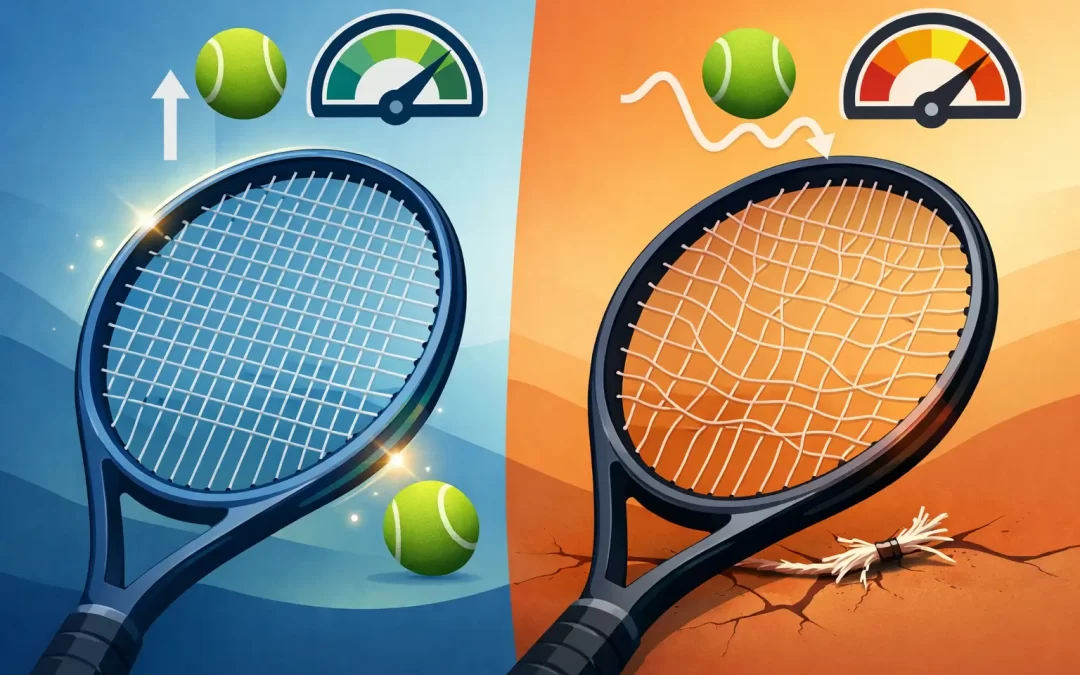
A racquet can look perfectly fine and still stop playing the way you expect. The ball begins to launch higher, your usual targets feel less reliable, and contact loses that crisp, connected response. So, can tennis strings lose tension? Absolutely. Every string bed loses tension, starting from the moment it comes off the stringing machine.
That does not mean your strings become useless overnight. The real question is how quickly tension drops, how much the change affects your game, and when the performance trade-off becomes too large. For players who value control, spin, comfort, and predictable depth, understanding tension loss is one of the smartest equipment advantages available.
Can Tennis Strings Lose Tension? Yes, Even Before You Play
String tension is not fixed. When a racquet is strung at 52 pounds, that is the reference tension applied during installation, not a permanent setting the string will hold forever. Once the string is clamped, tied off, and allowed to settle in the frame, it begins to relax.
The first drop often happens before the racquet ever reaches the court. This is called initial tension loss. Then, every impact, temperature change, and hour of play continues the process. A string bed also loses stiffness over time, which is why a racquet can feel livelier, less controlled, or simply dull even if the strings have not broken.
For tournament players, that shift can show up quickly. For a recreational player, it may be gradual enough that the racquet just starts feeling “off.” Either way, the strings are changing the response of every shot.
Tension Loss Is Not the Same as String Breakage
Broken strings make the decision easy. But waiting for a string to break is not always the best approach, especially with durable polyester strings. Many players cut out polyester long before it snaps because it has gone dead, lost elasticity, and stopped offering the controlled response it had when fresh.
A string bed can retain enough physical integrity to survive another several sessions while no longer delivering its best feel or performance. That gap matters most for players who hit with pace, use heavy topspin, or depend on precise directional control under pressure.
Why Tennis String Tension Drops
All strings relax, but the rate and feel of tension loss depend heavily on material, construction, installation, and use. Natural gut, multifilament, synthetic gut, and polyester each behave differently.
Polyester and co-polyester strings are popular because they provide control, spin potential, and durability for modern, fast swings. Their trade-off is that they can feel firmer at first and may lose their optimal playing characteristics faster than their durability suggests. A co-poly can still be intact after many hours, yet its response may become harsh or unpredictable.
Multifilament strings are designed for comfort and power. They generally offer a more elastic, arm-friendly feel, but they can lose tension more noticeably over time and may fray or break sooner. Natural gut is known for exceptional feel and tension maintenance, although it requires more care around moisture and is usually a premium investment. Synthetic gut sits in the middle for many players, offering a balanced, affordable option with a familiar response.
Installation also matters. Stringers can use pre-stretching techniques, proper machine calibration, and sound knot work to help produce a more stable initial result. But no method eliminates tension loss. It only helps control it.
Heat and cold can also change how a string bed feels. A racquet left in a hot car can feel noticeably different from one stored at room temperature. Humidity, repeated hard impacts, off-center contact, and frequent play all add to the wear.
What Loose Strings Feel Like on Court
Lower tension usually creates more trampoline effect. The ball may leave the string bed with more launch and depth, which can feel like welcome power for some players. But if the change goes too far, the racquet can become difficult to trust.
You may notice that your forehand starts sailing long unless you add more spin. Flat serves can lose their usual accuracy. Volleys may feel less crisp, and touch shots can become harder to judge. Players often respond by swinging more cautiously or trying to guide the ball, which usually makes the problem worse.
The effect is not always just extra power. Dead polyester can feel both underpowered and uncontrolled. The string has lost resilience, so the response can become muted at contact while the launch angle feels less consistent. That combination is frustrating because the racquet no longer gives clear feedback about what the ball will do.
Arm comfort is another factor. Fresh strings at a high tension can feel firm, especially in a stiff racquet. As tension drops, the bed may initially feel more comfortable. Once a polyester string becomes old and dead, however, some players experience a harsher impact because the string is no longer moving and recovering as effectively. If your elbow, wrist, or shoulder starts talking back, do not assume you simply need to play through it.
How Fast Different Strings Lose Tension
There is no single timeline because swing speed, racquet pattern, playing frequency, climate, and personal sensitivity all matter. Still, the material gives you a useful starting point.
Polyester and Co-Polyester
Polyester typically has the shortest peak-performance window. Competitive players may restring after roughly 8 to 15 hours of play, while players who hit exceptionally hard may prefer an even shorter cycle. A durable co-polyester can stay in the frame much longer, but durability is not the same as playability.
If you use polyester for control and spin, pay attention to when those benefits start fading. That is your restring signal, not necessarily the moment the string breaks.
Multifilament and Synthetic Gut
Multifilament and synthetic gut players often restring when the strings break, become deeply notched, or lose their preferred feel. These strings can remain playable for a longer period in terms of comfort, though their tension and response still change with use.
Players who want easy power and a softer impact may accept a little tension loss more readily than players whose game is built around aggressive baseline control.
Natural Gut and Hybrids
Natural gut is widely respected for holding tension well and preserving feel over time. It is a strong choice for players who want premium comfort, power, and touch, provided they protect it from excessive moisture.
Hybrid setups create useful trade-offs. A polyester main with a softer cross can balance spin and control with better comfort. A gut main with a polyester cross can deliver exceptional feel and tension maintenance, although the polyester cross will still change over time. The best hybrid is not universal – it depends on your swing, racquet, arm health, and priorities.
When Should You Restring Your Racquet?
A practical rule is to restring as many times per year as you play per week. If you play three times a week, plan on at least three restringings per year. That is a baseline, not a performance standard.
Players using polyester, competing regularly, or practicing several days a week will often need fresh strings far more often. Instead of relying only on a calendar, watch for changes in your ball flight, confidence, and comfort. If your normal swing suddenly produces inconsistent depth, or you have to make unusual adjustments to keep the ball in, inspect the strings first.
Fresh strings are especially valuable before a tournament, league playoff, important junior event, or extended training block. Do not test an old, uncertain string bed when the score matters.
How to Slow Tension Loss
You cannot stop strings from relaxing, but you can make smarter choices. Store your racquet indoors rather than in a car trunk or garage. Use a thermal racquet bag when conditions are extreme. Choose a string type and gauge that match your actual playing style instead of copying a professional setup built for a very different swing speed.
Lowering tension slightly can create more comfort and depth, while raising it can sharpen control for some players. Neither adjustment fixes old strings. If the bed is dead, adding pounds on the next restring may only make the fresh setup feel too stiff. Make one small adjustment at a time, usually 2 to 3 pounds, and evaluate it over several sessions.
A racquet technician can also help you track the setups that work. Keep a simple note on your phone with the string, gauge, tension, date, and how many hours you played. After a few restring cycles, you will know whether you prefer fresh co-poly at a lower tension, a comfort-focused multifilament, or a hybrid built around your game.
Profilex players can use that information to choose strings with purpose rather than guessing from a package. The right string setup should support the way you compete, not force you to change your strokes to compensate for worn-out gear.
Your strings are the only part of the racquet that touches the ball. When your response becomes inconsistent, trust what you feel, refresh the string bed, and step back on court with a setup that lets you swing freely.