
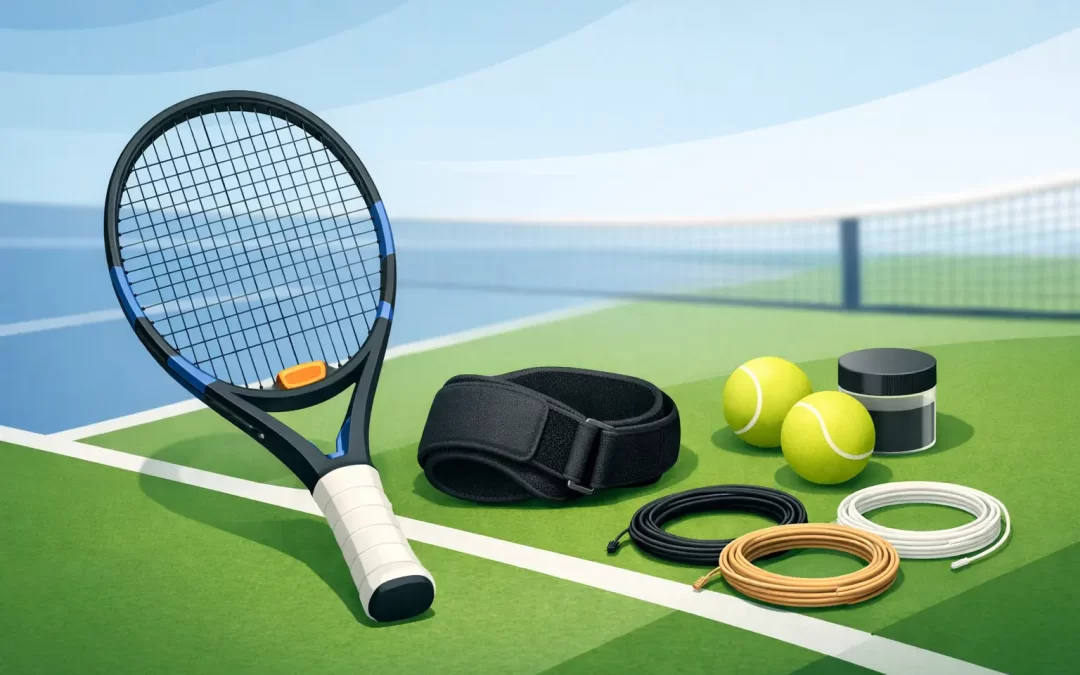
A good tennis elbow racquet setup example does not start with the stiffest frame or the most spin-focused polyester on the wall. It starts by reducing the harsh impact your arm absorbs while keeping enough control to swing with confidence. For most players, the winning adjustment is not one miracle racquet. It is a smarter system: a more forgiving frame, a comfortable string bed, sensible tension, and a grip that lets the hand stay relaxed.
Tennis elbow, often felt as pain on the outside of the elbow, can have several causes. Technique, training volume, recovery, and off-court strength all matter. Equipment cannot diagnose or cure an injury, and persistent pain deserves attention from a qualified medical professional. But the wrong racquet setup can keep loading an irritated arm on every late contact, off-center return, and heavy backhand.
The Tennis Elbow Racquet Setup Example We Recommend
For an adult intermediate player with recurring elbow discomfort who still wants a controlled, modern response, here is a strong starting point:
| Setup component | Example specification | Why it helps | |—|—|—| | Racquet head size | 100-102 square inches | A larger sweet spot reduces shock from off-center contact. | | Racquet weight | 10.8-11.4 ounces strung | Enough mass to stay stable without becoming hard to swing. | | Stiffness | RA 60-65, when available | A more flexible frame generally sends less sharp feedback into the arm. | | String | Multifilament or natural gut | These strings stretch and cushion impact better than firm polyester. | | Gauge | 16 or 17 gauge | A slightly thicker, durable comfort string is a practical choice. | | Tension | 50-54 pounds | Moderate tension supports comfort without making the response unpredictable. | | Grip | Correct size with a cushioned overgrip | Helps reduce excessive squeezing through impact. |
This is a baseline, not a prescription. A strong player with fast racquet-head speed may need more weight for stability. A junior transitioning from a light racquet may need a more manageable swingweight first. The goal is to build a setup that lets you strike the ball cleanly without bracing for impact.
Start With the Frame, Not the String
Players often try to solve elbow pain by changing string while continuing to use a very stiff, lightweight racquet. That can help a little, but the frame remains the foundation. A racquet that is too light for your pace gets pushed around at contact. The player then grips tighter, swings harder, and feels more vibration on mishits.
A frame in the 100 to 102 square inch range gives many club players an effective blend of access to spin, forgiveness, and directional control. It is not automatically better than a 98, but it gives the arm more margin when your feet are late or the ball arrives heavy. Competitive players who prefer a 98 can still create a comfortable setup, especially with a flexible frame and arm-friendly string.
Weight needs more nuance. More mass can be protective because the racquet does more of the work against a hard-hit ball. Yet a racquet that is too heavy can cause late contact and fatigue, especially during a long match. For many adult players managing elbow symptoms, 10.8 to 11.4 ounces strung is a practical window. Advanced players may be comfortable above that range, while developing players should prioritize a weight they can accelerate and control for a full session.
Stiffness also matters. Stiffer frames can feel lively and powerful, but they typically return more impact shock to the hand and arm. A frame with a lower-to-mid 60s stiffness rating is often a sound comfort target. Do not choose by stiffness alone, though. Balance, swingweight, beam design, and string choice all shape how a racquet feels at contact.
Why stability beats ultra-light maneuverability
An ultra-light racquet may feel easy to swing in the store, then feel unstable against real pace. When the hoop twists at impact, the forearm has to work harder to control it. That is exactly the type of repeated stress an irritated elbow does not need.
If you like your current frame but it feels hollow or gets pushed around, a racquet technician may be able to add a small amount of weight in a targeted position. This is a fine-tuning move, not a first response for every player. Added weight changes swingweight quickly, so test carefully and make small adjustments.
The Biggest Comfort Upgrade Is Usually the String
If there is one equipment decision that regularly separates a comfortable setup from a punishing one, it is string material. Full polyester is popular for its control, spin potential, and durability. It also has a firm response, loses elasticity over time, and can become demanding on the arm – particularly in a stiff frame at high tension.
For active elbow pain, move away from a full bed of firm poly. A quality multifilament is the most accessible starting point. It offers noticeably better pocketing and shock absorption while providing enough performance for recreational players, league competitors, and many juniors. Natural gut offers exceptional comfort, power, and tension maintenance, though it costs more and requires more care in wet conditions.
A hybrid can work when you want some of polyester’s control without making comfort an afterthought. Put natural gut or multifilament in the mains and a smooth, softer co-polyester in the crosses. The mains dominate the feel of the string bed, so this arrangement keeps more cushion in the setup. Avoid assuming any string labeled “soft poly” is harmless. Softer polyester is still polyester, and the difference may not be enough for an already sensitive elbow.
At Profilex, our recommendation is straightforward: restore comfort first, then add control only if your ball is consistently flying long. You can always refine tension or test a hybrid later. Continuing with a dead polyester string bed while trying to play through elbow pain is rarely the smart performance move.
Tension: do not chase control with excessive tightness
Higher tension can make a string bed feel more controlled, but it also makes impact firmer. With multifilament or gut, 50 to 54 pounds is a strong middle ground for many 100-square-inch frames. If you need more comfort and depth, move down two pounds. If the ball launches too high after a few sessions, move up gradually.
One adjustment at a time is the rule. A new racquet, a new string, a new tension, and a new grip all at once make it impossible to identify what actually improved your response.
Grip Size and Overgrip Can Change How Hard You Squeeze
A grip that is too small can encourage excessive wrist action and a tight hand. A grip that is too large can make the racquet feel difficult to maneuver and may strain the forearm differently. There is no perfect measurement for every player, but you should be able to hold the handle securely without clenching through the entire swing.
A cushioned overgrip can improve comfort and reduce vibration in the hand. It will not transform a harsh frame into an arm-friendly one, but it can make the right grip size feel more secure. Replace overgrips when they become slick. A slipping handle is an invitation to squeeze harder, especially in heat or pressure points.
Do not rely on a vibration dampener as the primary solution. Dampeners alter the sound and feel of string vibration, which some players enjoy, but they do not eliminate the main shock transmitted through the frame. Use one if you prefer it, not because it replaces a better frame-and-string decision.
Two Adjustments for Different Players
A doubles player who relies on quick hands and volleys may prefer a 100-square-inch racquet around 11 ounces, multifilament at 53 pounds, and a slightly head-light balance. That setup keeps maneuverability while giving enough stability for firm returns and reflex volleys.
A baseline player who normally uses full poly for heavy topspin may need a different path. Keep a stable 98 or 100-square-inch frame, lower the stiffness if possible, and begin with a gut/poly or multifilament/poly hybrid at modest tension. If the elbow remains reactive, remove the poly entirely for several weeks rather than trying to force a spin-first setup through pain.
For a competitive junior, resist the temptation to copy a professional’s heavy, tightly strung racquet. Junior players need a frame they can swing on time with a comfortable string bed that supports clean mechanics. Control comes from movement, contact, and training – not simply from the harshest setup available.
Test the Setup on Court, Not for Five Minutes
A racquet can feel comfortable during warm-up and become demanding after an hour of serves, defensive backhands, and late-match returns. Give a new setup at least two or three normal hitting sessions before judging it. Pay attention to where you feel fatigue, how hard you are gripping, whether off-center balls sting, and whether you can serve without guarding the arm.
If pain increases during play or lingers more intensely afterward, stop treating equipment as the only variable. Reduce load, assess technique and recovery, and get appropriate professional guidance. Smart gear supports the process, but it should never be used to ignore warning signs.
The best arm-friendly setup is the one that lets you swing freely, stay stable against pace, and trust your contact again. Build comfort into the frame and string bed first, then earn back the extra spin and control features your game demands.