
A racquet can look perfect on the spec sheet and still feel wrong when the match gets tight. Maybe it twists on a heavy return, arrives late on a fast forehand, or feels powerful for one set and exhausting by the second. That is where a tennis racquet customization guide becomes useful: small, measured changes can turn a good stock frame into a tool that fits your swing, strength, and match pattern.
Customization is not about making a racquet as heavy as possible or copying a professional player’s setup. It is about building a more predictable response. The right changes can improve stability, launch consistency, comfort, and confidence. The wrong changes can make a racquet sluggish, harsh, or difficult to control. Start with what your current frame does on court, then change one variable at a time.
Start With Your Racquet’s Playing Problem
Before adding weight, identify the problem you are trying to solve. A player who sprays balls long does not automatically need a heavier racquet. The issue may be a loose string bed, an overly powerful frame, poor contact, or a grip that prevents a relaxed swing. Equipment should support sound technique, not disguise every technical issue.
Pay attention during drills and match play. If the racquet gets pushed around on returns and defensive shots, it likely needs more stability. If you can generate pace but the head feels slow through contact, the balance may be too head-heavy for your swing. If your arm tightens after serving, comfort and overall mass deserve a closer look. A frame that feels unstable at the net needs a different solution than one that lacks depth from the baseline.
A few numbers matter most. Static weight is what the racquet weighs on a scale. Balance describes where that weight sits, either toward the head or the handle. Swingweight is how heavy the racquet feels while moving, and it has the biggest effect on timing, plow-through, and fatigue. Two racquets can weigh the same but play very differently because of their balance and swingweight.
Tennis Racquet Customization Guide: Weight Placement
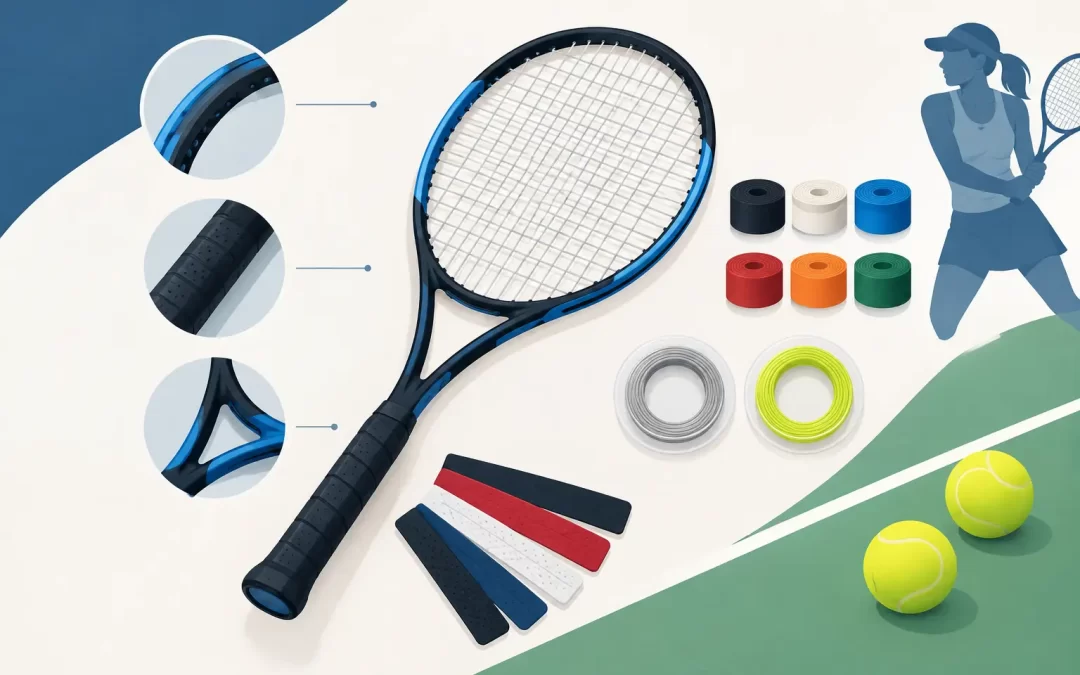
Lead tape and tungsten tape are the classic tools for precise racquet tuning. Tungsten is denser, so it delivers more weight in less space. Whichever material you use, measure carefully and apply matching pieces on both sides of the string bed. One gram can be noticeable to an experienced player, especially when it is placed near the tip.
Add Weight at 3 and 9 O’Clock for Stability
Adding equal weight at 3 and 9 o’clock makes the hoop more resistant to twisting. This is one of the best adjustments for players who frequently face heavy pace, block returns, or find the racquet unstable on off-center contact. It also enlarges the practical sweet spot without dramatically changing the racquet’s balance.
Start conservatively with two grams total, then test it. More is not always better. Too much weight in this area can make the frame feel less maneuverable on quick exchanges and reduce racquet-head speed on serves.
Add Weight at 12 O’Clock for Plow-Through
Weight at 12 o’clock raises swingweight quickly. It can add penetration to the ball, improve depth on a compact swing, and help a player drive through contact against a stronger opponent. Big hitters who want more mass behind the ball often like this position.
The trade-off is clear: this is the placement most likely to slow down your swing. A small addition at 12 can transform a racquet, but it can also make late contact worse if your preparation is already rushed. Test one to two grams before going further.
Add Weight at the Throat for a More Solid Feel
Weight around the throat, roughly at 5 and 7 o’clock, adds some stability with a more moderate swingweight increase than 12 o’clock. It can be a smart middle ground for all-court players who want a firmer response but still need fast handling at net.
This location does not create the same plow-through as the tip, nor does it protect against twisting as effectively as 3 and 9. Its value is balance. It often helps players refine a racquet that is close to right rather than solve a major performance problem.
Counterbalance in the Handle
Once weight is added to the hoop, the racquet may become too head-heavy. Counterbalancing with weight under the grip or inside the butt cap restores a more head-light feel while preserving the hoop’s added stability. This is especially useful for advanced players who want a higher swingweight but still need the racquet to come through quickly on serves, returns, and reaction volleys.
An overgrip is the simplest form of handle customization. It adds roughly five to eight grams, depending on the model, and slightly increases grip size. For a more permanent adjustment, a qualified racquet technician can add silicone or weighted material inside the handle. That work should be measured, not guessed. A few grams in the handle can change feel significantly without adding much power.
Build Around Swingweight, Not Just Static Weight
Many players chase a target weight, such as 11.5 ounces, without considering how the racquet swings. That can lead to a setup that looks right but performs poorly. A 11.5-ounce racquet with a high swingweight can feel demanding and powerful. Another at the same weight with more mass in the handle can feel fast and controlled.
For recreational players, a manageable swingweight usually produces better results than a demanding pro-style build. You need enough mass to stay stable through contact, but not so much that your swing slows late in a third set. Serious competitors can handle more swingweight if they have efficient mechanics and train consistently, yet even advanced players should prioritize repeatable timing over maximum mass.
The best test is not a few clean forehands during warm-up. Hit serves, return serves, play quick volley exchanges, and defend from a stretched position. If the racquet performs only when you are fresh and perfectly set, it is probably too demanding for match play.
Customize Grip Size and Shape Before Chasing More Weight
Grip setup affects every shot because it changes how securely and freely you hold the racquet. A grip that is too small can encourage excess wrist action and twisting. One that is too large can limit feel, spin, and grip changes. Your hand should feel connected to the handle without needing to squeeze it tightly.
An overgrip is a practical way to build up a handle gradually. A heat-shrink sleeve creates a more substantial, permanent increase, but it also adds weight lower in the frame. That can be useful if you are counterbalancing hoop weight, although it may change the handle shape and should be installed carefully.
Handle shape matters as well. Some players prefer a more rectangular feel for identifying their grips, while others like a rounder handle for quicker transitions. Do not alter handle shape casually. If you are moving between brands and a familiar grip feels strange, spend time with an overgrip and proper technique before assuming the frame itself is wrong.
Strings Complete the Custom Setup
A customized racquet with the wrong string setup is only half-finished. Strings influence launch angle, spin, pocketing, comfort, and control more immediately than most players expect. If you add mass and suddenly gain depth, you may need slightly more control from your string tension or string selection.
A shaped co-polyester can help fast, aggressive players control a heavier, more powerful build. But a full bed of firm poly at high tension can become uncomfortable, particularly in a stiff frame or for a player with arm sensitivity. A softer co-poly, a hybrid with multifilament, or lower tension may deliver a better balance of control and comfort. Profilex Performance Co-Poly strings are designed for players who want a controlled, spin-friendly response without treating string choice as an afterthought.
Keep tension changes modest. Adjusting by two pounds is enough to feel a difference. Change the string setup or the racquet weighting first, not both on the same day, or you will not know which variable produced the result.
Test, Record, and Match Your Racquets
Treat customization like a performance process. Record the racquet’s starting weight and balance, the exact amount and placement of added material, grip setup, string type, and tension. Then play with it long enough to evaluate it under pressure. A setup that feels impressive for 20 minutes may reveal weaknesses after two hours.
For players who carry multiple racquets, matching is a competitive advantage. Stock frames often vary slightly in weight and balance. If your primary racquet breaks a string in a tiebreak, the replacement should not feel like a different model. A racquet technician can measure and match frames for weight, balance, and swingweight, then build them toward a consistent target.
Juniors and players returning from arm trouble should be especially cautious. Adding mass can improve comfort by reducing shock and twisting, but an excessively heavy setup can strain the shoulder, wrist, or elbow when technique breaks down. Build gradually and stop if pain appears.
Your best setup is the one that lets you swing with intent on every ball: stable enough to absorb pace, quick enough to defend, and controlled enough to attack without hesitation. Start small, measure every change, and let match performance make the final call.