
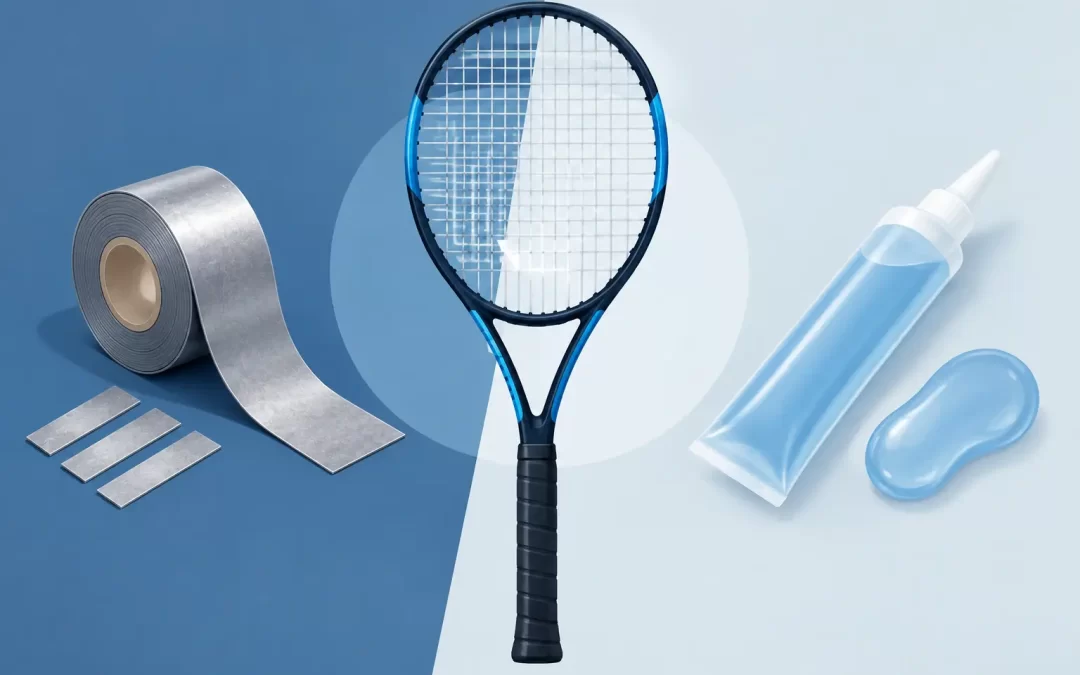
A racquet can be the right weight on paper and still get pushed around at contact, feel too quick through the hitting zone, or transmit more shock than you want. That is where lead tape versus silicone becomes a real customization decision, not a cosmetic tweak. Both can make a frame play more solid, but they change performance in very different ways.
Lead tape lets you place mass exactly where the racquet needs it. Silicone adds mass inside the handle, usually to create a more head-light balance and a more muted response. The best choice depends on what your current racquet does poorly, how much you value maneuverability, and whether you want a reversible adjustment or a long-term build.
Lead Tape Versus Silicone: The Core Difference
Lead tape changes a racquet according to where you apply it. A few grams at 3 and 9 o’clock can make the hoop more stable against heavy pace. Weight at 12 o’clock raises swingweight quickly and can add more plow-through, depth, and power. Tape near the throat provides a more moderate increase in static weight without making the racquet feel dramatically slower.
Silicone is placed inside the handle, generally under the butt cap or inside a hollow handle cavity. Its primary job is to increase static weight while shifting balance toward the grip. It has little direct effect on hoop stability because the added mass is so close to your hand. Instead, players notice a more substantial handle, a more head-light balance, and often a quieter, less hollow feel at impact.
Think of lead tape as a precision tool for altering swing characteristics. Think of silicone as a handle-based counterweight and feel adjustment. Many serious players use both: lead in the hoop to create the desired swingweight, then silicone in the handle to preserve a maneuverable balance.
What Lead Tape Changes on Court
The biggest advantage of lead tape is placement. You can solve a specific on-court problem rather than simply making the racquet heavier.
At 3 and 9 o’clock, lead tape increases twistweight. This is the adjustment to consider if your racquet twists on off-center returns, volleys, or defensive shots. The frame holds its line better against a heavy ball, and the sweet spot can feel more forgiving across the string bed. For doubles players, aggressive returners, and juniors facing bigger hitters, this placement often delivers an immediate improvement in stability.
At 12 o’clock, lead tape produces the largest swingweight increase for each gram added. The racquet carries more momentum through contact, which can help players drive the ball deeper and hit a heavier serve. The trade-off is clear: the racquet will be less maneuverable. If you are late on fast exchanges or struggle to accelerate the head on topspin strokes, too much weight at 12 can work against you.
At 10 and 2 o’clock, you get a blend of higher swingweight and better upper-hoop stability. This can suit players who want more penetration without making the racquet feel as tip-heavy as a pure 12 o’clock setup.
Near the throat, lead adds weight with a smaller balance shift than hoop placements. It is useful when a racquet feels too light overall but you do not want to substantially change its swing path.
Start conservatively. Even 2 to 4 grams total can be noticeable, especially in the head. Apply matching strips on both sides of the frame, hit with the setup for more than one session, and only then decide whether to add more. A racquet that feels fantastic for ten minutes can become sluggish during a third-set service game.
What Silicone Changes on Court
Silicone does not create the same power or stability boost as lead in the hoop. Its value is in balance, comfort, and feel.
When you add silicone to the handle, the racquet becomes more head-light relative to its total weight. That can restore quickness after adding lead higher on the frame. It can also make a heavier racquet easier to whip through serves, returns, and rapid net exchanges because more of the mass sits close to your hand.
Many players also prefer the dampened response silicone can create. It may reduce the sharp, hollow vibration that some modern frames produce, particularly on shots struck outside the sweet spot. This does not mean silicone is a cure for arm pain. String type, tension, technique, grip size, and overall racquet stiffness all matter far more. But for a player who likes a more connected, muted impact feel, silicone can be a meaningful part of a custom build.
The drawback is that silicone is not a quick experiment. Accessing the handle usually requires removing the butt cap, and the material needs to be installed carefully so it does not rattle or interfere with the trap door. Once cured, it is far harder to remove than tape. Racquet technicians often use silicone when a player has already proven the target specification and wants a permanent, clean result.
Which Option Fits Your Goal?
Choose lead tape when your main issue is performance at the hoop. If you want greater stability against pace, more power through the court, a heavier ball, or a higher swingweight, lead tape is the direct answer. It is also the better choice for players who are still testing specifications because it can be removed, repositioned, and adjusted in small increments.
Choose silicone when your racquet already has enough swingweight but feels too head-heavy, too hollow, or too light in the handle. It is especially useful as counterweight after a hoop customization. A player may love the added plow-through from lead at 3 and 9, then find the frame slower on reaction volleys. Silicone in the handle can bring the balance back without taking away the hoop stability that made the setup effective.
If comfort is your central concern, do not assume silicone is automatically the answer. A softer multifilament or natural gut string, a lower tension, and an arm-friendly frame can make a larger difference. Silicone can refine feel, but it cannot override a stiff polyester string bed at an aggressive tension.
A Smart Way to Build Your Setup
Start by measuring your unmodified racquet. Static weight, balance, and swingweight give you a baseline and prevent guesswork. Two racquets with the same listed specification can vary enough in production that matching by feel alone can be misleading.
Then identify one problem. Do not add weight everywhere because you want “more performance.” If the racquet is unstable on returns, test a small amount at 3 and 9. If groundstrokes land short despite clean contact, try a modest amount higher in the hoop. If the racquet has become too head-heavy after customization, counterweight the handle with a temporary solution first, such as a little weight under the grip, before committing to silicone.
A practical process looks like this:
- Make one placement change at a time and test it during real point play.
- Add weight in small, symmetrical amounts to keep the racquet balanced side to side.
- Track static weight, balance, and swingweight after every change.
- Match both racquets if you play with multiple frames.
The last point matters more than most players realize. One customized racquet and one stock backup can create timing issues the moment you switch frames during a match. Competitive players benefit from matched swingweight and balance, not simply matching scale weight.
Safety and Installation Considerations
Lead tape is effective, but lead requires sensible handling. Keep it away from children, avoid touching your face while applying it, wash your hands after use, and cover the tape securely with finishing tape or a protective layer. Do not use loose or damaged strips. If you prefer to avoid lead entirely, tungsten tape is a common alternative, though it may require more material to reach the same weight.
Silicone installation is best treated as a technician-level job, particularly if you care about exact matching. Too much material, poor placement, or an unsecured butt cap can leave you with an unwanted rattle and a specification that is difficult to correct. A professional racquet technician can help build toward a target weight, balance, and swingweight rather than simply adding grams until the racquet feels different.
The winning setup is not the heaviest one. It is the one that lets you swing freely, arrive on time, and trust the racquet when the point gets tight. Test with purpose, make small changes, and build a frame that supports the way you want to play.