
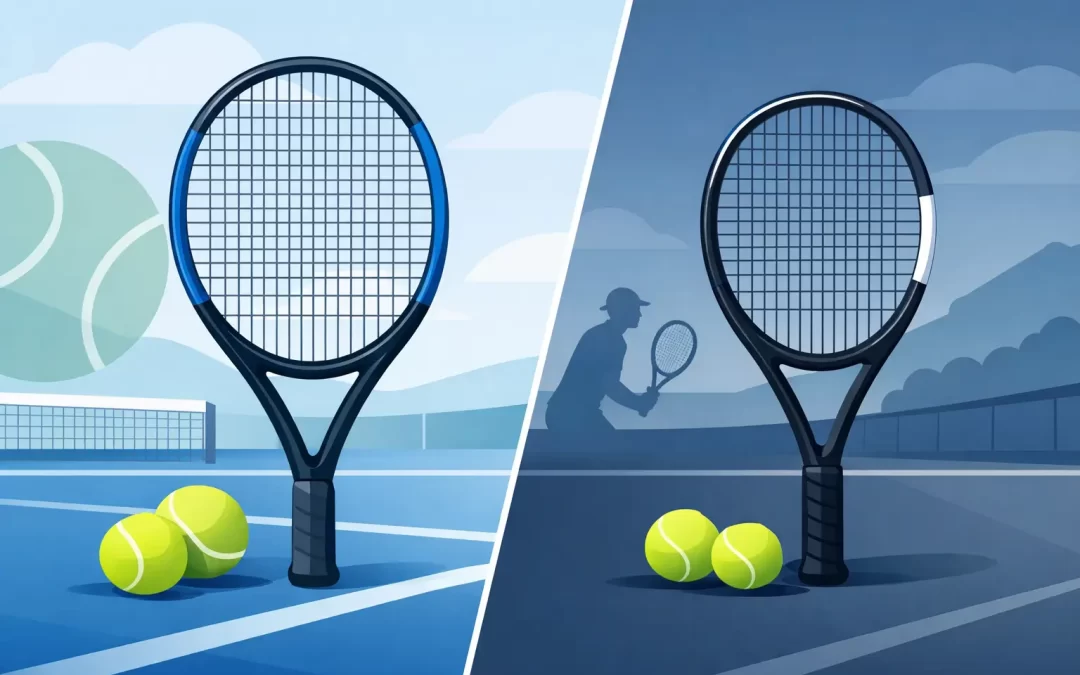
A racquet can feel perfect in the first five minutes of a hit, then fall apart when you are stretched wide on a big point. That is why the oversize vs midplus tennis racquet decision should not start with what a pro uses or what looks powerful on a product page. It starts with where you make contact, how hard you swing, and which misses cost you the most.
Head size changes the usable hitting area, launch response, and stability you feel at impact. It does not work alone, of course. Weight, balance, stiffness, string pattern, and string setup all matter. But head size is one of the fastest ways to narrow the field and put a player in a frame that supports better tennis.
Oversize vs Midplus Tennis Racquet: The Core Difference
An oversize tennis racquet generally has a head size of 105 square inches or larger. The largest conventional models often reach 115 square inches. A midplus racquet usually falls between 95 and 104 square inches, with 98 and 100 square inch heads dominating the modern performance category.
More square inches create a larger sweet spot and a more forgiving response when contact drifts toward the hoop. That is the central benefit of an oversize frame. A midplus frame has a smaller hitting surface, but it typically gives stronger players a more connected, predictable feel when they swing aggressively and strike the ball in front.
Neither category is automatically better. Oversize is not just for beginners, and midplus is not only for advanced tournament players. The right choice depends on whether you need the racquet to supply more help or whether you need it to stay composed while you supply the pace.
What an Oversize Racquet Does Best
An oversize racquet is built to make tennis easier at contact. Its larger head gives you more margin when returning serve, defending against pace, and making a compact swing under pressure. Players who frequently hit the upper hoop or outside edge of the string bed will immediately notice the benefit.
The larger string bed can also provide more inherent power. The strings have more room to deflect and rebound, helping the ball leave the racquet with less effort. For a player with a shorter swing, a developing junior, or a doubles player who wants quick depth on volleys and returns, that extra response can be a real advantage.
Comfort is another reason many players should consider oversize. A larger head often reduces the harshness of off-center contact because the sweet spot is more generous. That does not mean every oversize racquet is soft, but it can be an excellent starting point for players managing arm discomfort or those who do not consistently strike the center of the strings.
There are trade-offs. Bigger heads can feel less precise on full cuts, particularly if the frame is light and head-heavy. Some players find that the ball launches higher than expected, making it harder to drive shots through the court. At net, a large head may also feel slower to position during fast exchanges.
Oversize is a strong fit when you need forgiveness
Choose an oversize racquet if you want easier depth without overswinging, struggle to find the sweet spot, or rely on quick, compact strokes. It also makes sense for players returning after time away from the game. There is no performance award for using a demanding frame that turns routine balls into errors.
An oversize model can be particularly effective for doubles specialists. You get a forgiving platform for reaction volleys, return blocks, overheads, and defensive pickups. The best option is usually one with enough overall weight and stability that it does not get pushed around by a hard serve.
Why Midplus Dominates Modern Performance Tennis
Midplus racquets are the all-around performance standard because they balance forgiveness with precision. A 100 square inch head gives most recreational and competitive players enough sweet spot to play confidently while maintaining a controlled, maneuverable response. A 98 square inch frame usually asks for cleaner contact but rewards committed acceleration with lower, more precise ball flight.
For players who generate their own racquet-head speed, midplus designs generally offer better directional confidence. You can swing through a forehand, attack a short ball, or take a backhand early without feeling like the frame is adding too much lift or pace. That control becomes more valuable as your strokes become faster and more repeatable.
Midplus frames also tend to suit spin-based baseline tennis. The head size itself does not create spin, but the combination of a manageable head, modern beam geometry, and an open string pattern can help players brush up the back of the ball with speed. A 100 square inch racquet with a 16×19 pattern is one of the most versatile setups in the game for this reason.
The compromise is less free help. A midplus racquet will expose lazy footwork and late contact more quickly than an oversize model. If you are regularly under-hitting the ball, framing shots, or finishing matches with arm fatigue, a smaller head may be asking more of your game than it gives back.
The 98 versus 100 square inch decision
For many serious players, the real decision is not oversize versus midplus. It is 98 versus 100.
A 98 square inch racquet commonly appeals to advanced players with long, fast strokes. It can feel more surgical on returns, passing shots, and aggressive backhands. The smaller head often pairs with a heavier, more control-oriented build, although specifications vary by model.
A 100 square inch racquet is the safer all-court choice for a broad range of players. It offers meaningful forgiveness without giving up the performance profile needed for league matches, tournament play, and high-level training. If you are torn between the two, a 100 is often the smarter first demo unless your ball striking is already a clear strength.
Match Head Size to Your Swing and Court Position
Your swing length is more useful than a self-rating when choosing a racquet. Players with compact to medium swings often benefit from the easy depth and larger margin of an oversize head. Players with medium to full swings usually have the mechanics to take advantage of a midplus racquet’s control.
Court position matters too. A player who spends most points several feet behind the baseline needs enough power and spin potential to push opponents back. That can come from either head size, but a midplus frame with the right string setup is usually more predictable for a player who attacks from the baseline. A player who plays doubles, chips returns, and closes at net may value an oversize frame’s quick forgiveness more than maximum swing freedom.
Do not ignore physical needs. If a racquet feels demanding after one hard set, it will not become easier in the third. Oversize heads can make contact more comfortable, while midplus frames with flexible beams, appropriate weight, and arm-friendly strings can also protect the arm. The complete setup matters more than the head-size label alone.
Strings Can Change the Answer
The string bed can make an oversize racquet more controlled or a midplus racquet more forgiving. This is where players often leave performance on the table.
A powerful oversize frame may benefit from a firmer string, a slightly higher tension, or a control-focused polyester for players with healthy arms and faster swings. A comfortable multifilament can be the better choice for players who want maximum feel and easy depth. Because oversize heads have longer strings, they can feel livelier at the same tension than a smaller-head racquet.
With a midplus racquet, the goal is usually to preserve the frame’s intended balance. A 98 or 100 square inch performance frame can pair well with shaped polyester for spin and durability, or with a hybrid that adds comfort and touch. If you use a full polyester setup, do not assume tighter is better. Excessive tension can shrink the sweet spot and make a solid racquet feel harsh.
Profilex racquet technicians see this often: players blame a frame for a launch or comfort problem that is really coming from an old string bed, an unsuitable tension, or a string choice that does not match their swing speed.
How to Test Before You Commit
If you can demo, test racquets against your normal level of pace. A casual five-minute rally is not enough. Hit returns, high backhands, defensive forehands on the run, volleys, and serves after you are a little tired. Those shots reveal whether the head size is helping your game or simply feeling good at easy contact.
Pay attention to your ball’s depth and shape. With an oversize racquet, ask whether you can still drive the ball down into the court when you accelerate. With a midplus racquet, ask whether you can reliably get depth when you are late or off balance. The best racquet will not erase every miss, but it should make your common rally ball more reliable.
Also compare racquets with similar weight classes. Testing a light oversize frame against a heavy midplus frame tells you as much about mass and stability as it does about head size. Keep the variables as close as possible, including grip size and string type, so your feedback is useful.
The winning choice is the one that lets you swing with conviction on the shots you face most often. Pick the head size that turns more of your normal contact into quality ball striking, then build the rest of the setup around the way you want to compete.