
A racquet can feel fast through the air yet get pushed around by heavy pace. It can also feel solid on contact but arrive late when the point speeds up. When you customize racquet swingweight safely, you are not just adding weight – you are tuning how much force it takes to accelerate the frame. Done with a plan, a small change can produce a more stable, penetrating ball. Done carelessly, it can cost you timing, racquet-head speed, and arm comfort.
Swingweight customization is one of the most effective ways to make a racquet play more like your game. The key is to measure first, add weight in small increments, and test under real match conditions before making another change.
What Swingweight Actually Changes
Swingweight is a measurement of a racquet’s resistance to rotation during the swing. A higher swingweight means the racquet feels heavier to accelerate, especially at the top of the hoop. It also carries more momentum into the ball, which can improve stability against pace, depth on defensive shots, and plow-through on a full swing.
Static weight and swingweight are related, but they are not the same. Add five grams under the grip and your racquet becomes heavier on a scale, yet its swingweight changes very little. Put those same five grams near 12 o’clock and the frame will feel substantially more demanding to swing.
For many adult players, a strung swingweight around 315 to 330 offers a balanced blend of speed and stability. Strong intermediates and advanced competitors may prefer 330 to 345 or higher. Those ranges are not rules. A player with compact strokes may handle a higher number well, while a player who relies on late, fast defense may play better with less.
Start With a Real Baseline
Before changing anything, record the racquet’s current specifications. The most useful numbers are strung weight, balance point, swingweight, grip size, and string setup. If possible, use the same overgrip, dampener, and strings you normally play with. A different string gauge or a fresh overgrip can change the final feel enough to confuse your testing.
A swingweight machine provides the cleanest baseline, but a knowledgeable racquet technician can also help identify whether your frames are closely matched. This matters most if you own two or more racquets. Customizing one frame without comparing it to the others can leave you switching between racquets that swing and respond differently under pressure.
Pay attention to what happens on court, not just the number. Are off-center returns twisting the frame? Does the ball land short when you defend from behind the baseline? Are you late on fast exchanges or struggling to generate racquet-head speed on serves? Those answers tell you whether more swingweight will solve a problem or simply make it worse.
Customize Racquet Swingweight Safely With Small Adds
The safest adjustment is usually one to two grams at a time. That may sound minor, but placement multiplies the effect. One gram at 12 o’clock can add roughly three swingweight points on a standard 27-inch racquet. Two grams there can create a noticeably heavier, more powerful response.
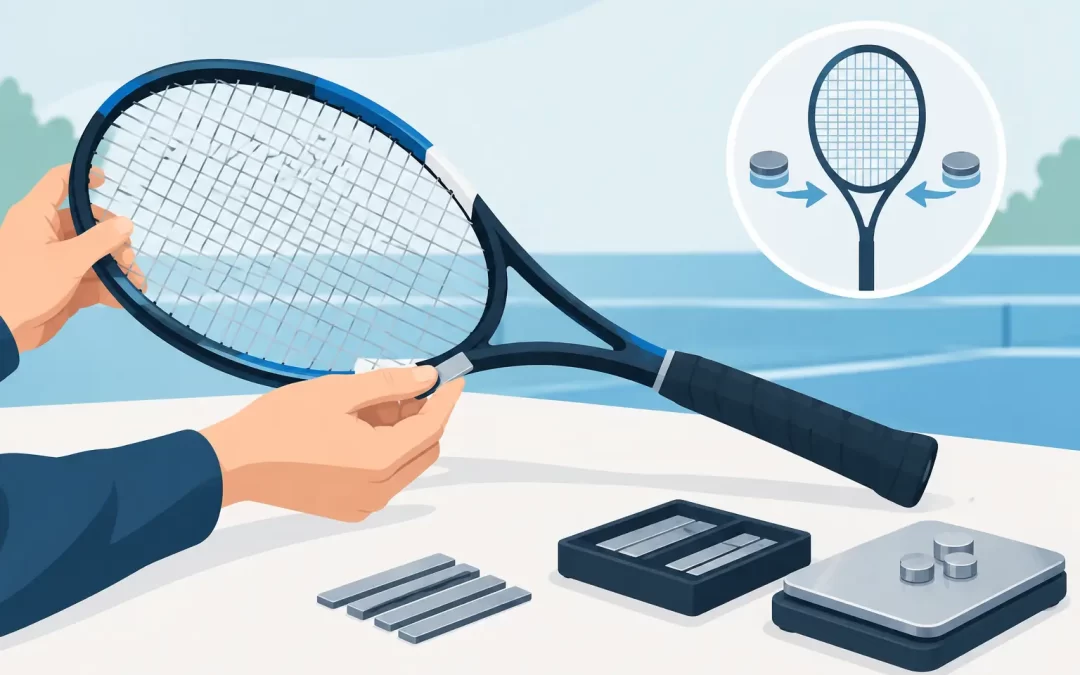
Use a scale that measures to at least one-tenth of a gram, cut identical strips for each side of the hoop, and write down every change. If you add weight at 3 and 9 o’clock, keep the strips symmetrical. An uneven setup can make the racquet feel unstable or pull differently through contact.
Test each adjustment for at least one or two full hitting sessions. Start with groundstrokes and returns, then hit serves and overheads when your shoulder is already working. The first ten minutes often feel great because added mass makes the ball jump off the strings. The real question is whether you can still accelerate the racquet cleanly late in a set.
Stop adding weight when your forehand begins arriving late, your serve loses snap, or your wrist, elbow, or shoulder starts compensating. More mass is not automatically more performance. The best setup is the heaviest swingweight you can accelerate consistently with relaxed mechanics.
Choose Placement Based on Your Goal
Where you place weight determines what you feel. There is no universal “best” location because the right solution depends on your stroke pattern and the problem you are trying to correct.
- At 12 o’clock: This produces the largest swingweight increase per gram. It can add depth, power, and a heavier ball, but it is also the easiest way to make a racquet sluggish on quick exchanges.
- At 10 and 2 o’clock: This raises swingweight while expanding support higher in the hoop. It suits players who want more stability and a fuller response on balls struck above center.
- At 3 and 9 o’clock: This improves torsional stability, helping the racquet resist twisting on off-center contact. It is a strong option for returners, doubles players, and baseliners facing heavy pace.
- At the throat or lower hoop: This adds some mass and firmness with a more moderate swingweight increase. It can be useful when you want a more connected feel without dramatically slowing the frame.
If your racquet becomes too head-heavy after hoop weighting, add a small amount of counterweight under the grip or inside the butt cap. Counterweight can restore a more head-light balance and improve maneuverability, but it does not erase the swingweight you added. The racquet will still require more force to accelerate than it did before.
Use the Right Materials and Secure Them Correctly
Lead tape has been a standard customization material for decades because it is thin, dense, and easy to position precisely. Handle it carefully, avoid touching your face while applying it, wash your hands afterward, and cover it securely with finishing tape or protective tape. Never leave loose lead tape exposed where it can peel during play.
Tungsten tape or tungsten putty is a good alternative for players who prefer to avoid lead. Tungsten is generally bulkier than lead for the same amount of weight, so it may be less convenient in tight areas, but it remains highly effective for controlled adjustments.
Keep hoop tape smooth and firmly attached. A loose edge can catch, shift the balance, or detach during a serve. Do not block grommets, create sharp tape edges near the string bed, or stack large amounts of material in one spot. If you need more than several grams to get the response you want, the racquet’s original specification may simply not be the right starting point.
Protect Your Arm While You Test
A higher swingweight can be comfortable for some players because the racquet is more stable and deflects less at impact. For others, especially those with a history of tennis elbow or shoulder pain, added mass can increase fatigue and stress when timing breaks down. Comfort depends on the entire setup: racquet stiffness, string type, tension, technique, and recovery all matter.
If you are managing arm discomfort, avoid making a swingweight jump right before a tournament or league match. Test during practice, use a string setup you know well, and watch how your arm feels the next morning. A soft multifilament or a comfortable co-poly at a sensible tension may complement a customization better than a stiff, high-tension string bed.
Junior players deserve extra caution. Their strength, technique, and physical development change quickly, so an adult-style heavy customization can limit swing speed and encourage inefficient mechanics. For competitive juniors, small, technician-guided changes are the smart route.
Match the Racquet to Your Competitive Needs
Customization works best when it supports a clear playing identity. A counterpuncher who absorbs pace may benefit from extra stability at 3 and 9. An aggressive baseliner with long strokes may like a modest amount at 12 for a heavier ball. A doubles player who lives at the net may prioritize a faster, more maneuverable setup over maximum plow-through.
At Profilex, our racquet and string experience starts with that on-court reality: the right specification is the one that helps you swing freely, control the point, and trust your equipment when the score gets tight. Make one measured change, give your body time to adapt, and let your results – not the scale alone – determine the final setup.