
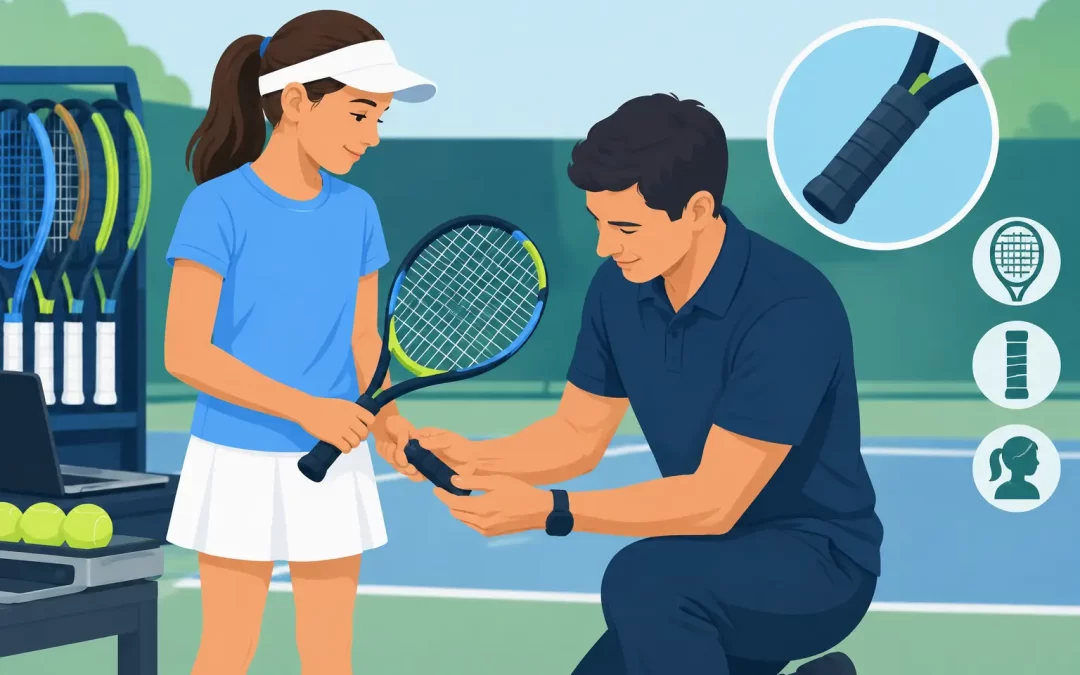
A 10-year-old who is tall, athletic, and practicing three days a week should not automatically use the same racquet as a 10-year-old who plays once a week. That is the point of a proper junior racquet fitting example: age is a starting point, not the final answer. The right racquet helps a young player swing freely, find the center of the strings, and develop strokes that will hold up as the pace increases.
A racquet that is too short or too light can feel easy for five minutes, then get pushed around by the ball. One that is too long, too heavy, or too demanding can make a junior late to contact and encourage cramped, compensating mechanics. Parents often shop by age label alone. Coaches and experienced racquet technicians look at the player in front of them.
A Junior Racquet Fitting Example: Meet the Player
Consider a competitive 10-year-old named Ava. She is 4 feet 8 inches tall, strong for her age, and has played organized tennis for two years. She attends group training twice a week, takes one private lesson, and plays weekend match play. Ava can rally consistently from the baseline, uses a developing topspin forehand, and is beginning to serve with a full motion.
She currently uses a 25-inch junior racquet. It was a sensible choice a year ago, but she now contacts the ball too close to her body at times and struggles to create depth when facing stronger players. Her coach notices that she swings with good speed, but the racquet does not give her enough reach or stability against a faster ball.
The fitting recommendation is likely a 26-inch junior racquet rather than an immediate move to a 27-inch adult frame. The extra inch gives Ava more reach and leverage on groundstrokes and serves without forcing her to manage the added length and weight of a full-size racquet. A typical 26-inch model in an appropriate junior weight range provides a better platform for her next stage of development.
That recommendation is not based on height alone. It reflects Ava’s strength, her ability to accelerate the racquet, the frequency of her training, and the level of ball she faces. A less experienced player at the same height may still be better served by a 25-inch racquet, especially if they cannot swing the longer frame comfortably through a full practice.
Start With Length, Then Test the Swing
Junior racquet length is the first major fitting decision because it affects reach, leverage, timing, and maneuverability. Common guidelines are useful, but they are not rules written in stone. Many players fit broadly into these ranges:
- 21-inch racquets often suit younger children around ages 4 to 6.
- 23-inch racquets commonly fit players around ages 6 to 8.
- 25-inch racquets are a frequent fit for players around ages 8 to 10.
- 26-inch racquets often work well for advanced 9- to 11-year-olds and developing competitors.
- 27-inch adult racquets are usually appropriate only when a junior has the height, strength, technique, and training volume to handle one.
A good on-court check is simple. Have the player hit forehands, backhands, volleys, and serves with the candidate racquet for 10 to 15 minutes. Watch whether the swing remains fluid as fatigue begins to show. If the player has to choke up on the handle, consistently arrives late, or drops the racquet head below the ball because it feels unwieldy, the frame is likely too much racquet right now.
Do not confuse a longer racquet with automatic improvement. Length can add reach and leverage, but only if the junior can accelerate and control it. Clean contact and repeatable mechanics will produce more results than an oversized frame that the player cannot move on time.
Weight Matters More as Competition Gets Serious
Once length is right, weight becomes the performance variable that most changes the racquet’s feel. A heavier frame is generally more stable at contact and can help a junior drive through the ball. It also requires more strength and better preparation. Too much weight can slow the swing, strain a developing arm, and make a player rely on short, defensive strokes.
For Ava, a light but not flimsy 26-inch racquet is the target. She needs enough mass to stop the racquet from twisting when she returns pace, but not so much that she loses racquet-head speed or struggles to serve late in a session. The goal is controlled acceleration, not simply putting the heaviest frame possible in the hands of a promising player.
This is where junior racquets vary more than many parents expect. Two racquets can be the same length yet feel completely different because of their balance, beam design, swingweight, and string pattern. A head-light frame may move quickly at net, while a more evenly balanced frame can feel more solid from the baseline. The player should choose the option that supports their current game while leaving room to grow.
Grip Size and Strings Complete the Fit
A junior should be able to hold the racquet securely without squeezing the handle as hard as possible. An oversized grip makes it difficult to change grips and generate feel, while an undersized grip can encourage excessive wrist action and instability. Most junior frames come with smaller grip sizes, but checking the fit still matters, particularly as a child approaches an adult racquet.
Strings also deserve attention. For most juniors, comfort and playability should take priority over maximum durability. A soft synthetic gut or multifilament at a moderate tension is usually a smart starting point. It gives the player a responsive string bed, helps with comfort, and makes it easier to learn to shape the ball.
A full bed of stiff polyester is rarely the best first choice for a young player. Polyester can offer control and durability for advanced, high-speed swings, but it is less forgiving and can feel harsh when the player does not generate enough pace. A stronger junior who breaks strings and trains at a high level may eventually benefit from a carefully selected co-polyester setup, often as part of a hybrid, but that decision should follow the player’s development instead of leading it.
At Profilex, our fitting mindset is built around the full setup: racquet length, weight, grip, string type, and the player’s actual on-court demands. The best equipment choice is the one that gives a junior confidence to swing with intent without asking their body or technique to do more than it is ready for.
When Should a Junior Move to a 27-Inch Adult Racquet?
The jump to an adult racquet is a milestone, not a birthday present. Some highly trained 10- or 11-year-olds are ready, particularly if they are tall, physically mature, and regularly competing with faster balls. Others may benefit from a 26-inch racquet well into age 12. There is no penalty for waiting when the current racquet still supports strong mechanics.
A player may be ready to test a 27-inch frame when they can consistently rally with depth, prepare early under pressure, serve with a complete motion, and handle a longer racquet without losing speed or control. Start with a lighter adult model rather than a demanding tour frame. A 100-square-inch head size and a manageable weight can offer useful forgiveness during the transition.
The wrong move is giving a junior an adult racquet because it looks more serious. Serious players use equipment they can control. The right racquet should make a player more decisive on the ball, not more cautious.
Recheck the Fit as the Player Changes
Junior fitting is not a one-time purchase decision. Growth spurts, stronger shoulders, improved footwork, a move to a faster ball, and a more competitive schedule can all change what a player needs. Reassess the racquet at least once a season, and sooner if the player starts looking cramped, late, or unusually fatigued.
Watch for the positive signs, too: relaxed swings, reliable contact, better depth, confident serving, and a player who wants to take the racquet into match play. Give young competitors equipment that matches their game today, then let their work ethic and development determine the next step. That is how a racquet becomes a tool for better tennis, not an obstacle to it.