
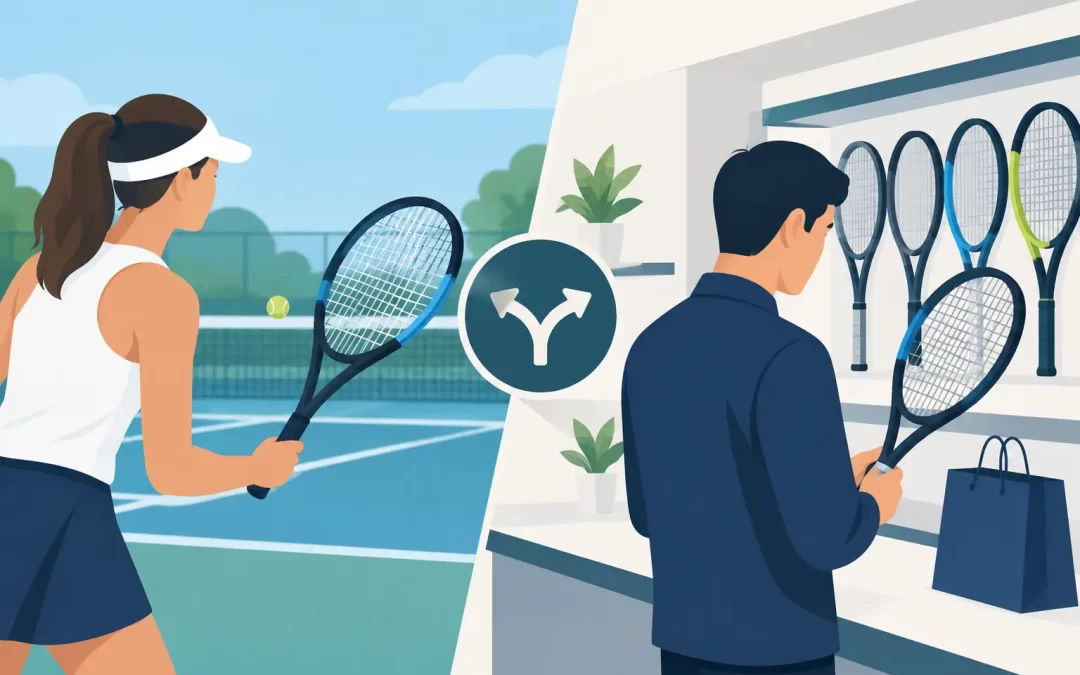
A racquet can feel perfect during five minutes of shadow swings and completely wrong when you are late on a second-serve return. That is why the racquet demo versus purchase decision deserves more than a quick look at the spec sheet or a favorite pro’s paintjob. The right frame needs to perform under your swing, your timing, and the pressure of real points.
For some players, buying directly makes sense. For many others, especially competitors changing frames or juniors moving into a heavier model, a demo is the smarter first move. The key is knowing what a demo can reveal, what it cannot, and when a confident purchase is the better play.
Racquet Demo Versus Purchase: What You Are Really Choosing
You are not simply choosing between borrowing a racquet and buying one. You are choosing between testing a performance tool in real conditions or committing based on specifications, reputation, and experience with similar frames.
A racquet’s listed head size, weight, balance, and string pattern give you a strong starting point. A 98-square-inch, 305-gram frame with a 16×19 pattern may look ideal for an aggressive all-court player. But specs do not tell you whether the racquet comes through quickly enough on your backhand return, whether it stays stable against heavy pace, or whether the response feels connected when you flatten out a short ball.
That is where a demo earns its value. It turns a technical description into on-court evidence.
Buying without a demo is not automatically a mistake. Players who know their preferred family of racquets, understand their ideal weight range, and have a consistent string setup can make a highly informed purchase. If you have played successfully with several generations of the same model line, a direct purchase may be reasonable. The risk increases when you are making a significant change in head size, weight, stiffness, balance, or string pattern.
What a Racquet Demo Shows That Specs Cannot
The best racquet is not necessarily the one that feels most powerful for the first ten balls. It is the one that helps you produce your best ball quality after an hour of serving, defending, attacking, and competing.
Swingweight and maneuverability under pressure
Static weight matters, but swingweight often decides whether a racquet works for your game. Two frames can weigh the same on a scale and feel dramatically different through contact. One may drive through the ball with excellent stability but feel slow when you have to react to a fast body serve. Another may be easy to accelerate yet get pushed around against bigger hitters.
A demo lets you experience that trade-off. Test the racquet on return of serve, quick exchanges at net, and wide defensive forehands. If you are consistently late despite swinging hard, the frame may be asking too much of you. If it feels unstable when your opponent increases pace, you may need more mass or a different balance.
Comfort on your actual contact point
Comfort is personal. A frame that feels crisp and responsive to one player can feel harsh to another, particularly with polyester strings. Your swing speed, contact location, grip pressure, arm history, and string tension all affect the result.
During a demo, pay attention to feedback on off-center shots and late contact. Does the racquet remain comfortable when you are stretched? Does it feel predictable when you block a return? If you have dealt with tennis elbow, shoulder discomfort, or wrist irritation, do not judge comfort solely on clean baseline rallies. The demanding shots are the ones that expose a poor fit.
Launch angle, spin, and directional control
A racquet’s string pattern and beam design influence how the ball leaves the strings. Some frames produce an easy, higher launch that helps heavy topspin players clear the net with margin. Others offer a flatter, more direct response that rewards players who drive through the court.
Neither is better in every situation. A high-launch racquet may help a junior create shape and depth from the baseline, but it can make aggressive transition balls sail long if the player has a flatter swing path. A controlled, lower-launch frame may sharpen targeting for an advanced player, but it can require more racket-head speed to generate safe net clearance.
Test both your rally ball and your finishing ball. If you need to make major adjustments just to keep the ball in the court, the racquet may not match your natural game.
How to Demo a Tennis Racquet Like a Competitor
A demo should not be a casual hit with your usual partner. Give each frame a fair, repeatable test. Bring the same ball type, play on the same court when possible, and compare no more than two or three racquets in one session. Switching constantly makes it harder to identify what you are actually feeling.
Start with baseline rallies, then move through the shots that decide your matches. A useful demo session should include:
- Returns against pace, including body serves and wide serves
- Crosscourt forehands and backhands, then down-the-line changes of direction
- Volleys and overheads after quick movement forward
- First serves, second serves, and a short point-play segment
Keep a few notes immediately after each session. Rate power, control, spin access, stability, maneuverability, comfort, and serving confidence. Do not rely on memory after testing multiple frames. The racquet that felt exciting at first can look less convincing when you compare it against the one that helped you hit your targets more consistently.
String setup deserves special attention. A demo racquet may arrive with a string and tension that are not your normal setup, and that can change the response substantially. A tight polyester can make a comfortable frame feel boardy. A soft multifilament can make a control-oriented racquet feel more powerful than it will with your usual co-poly.
Use the demo to evaluate the frame’s fundamental behavior, not to chase a perfect final setup. Once you select the frame, dial in performance through string choice and tension. Players seeking more control and durability may prefer a performance co-poly setup, while players prioritizing comfort or easy power may benefit from a softer option or a hybrid.
When Buying Without a Demo Makes Sense
There are times when the purchase decision is clear enough to skip the demo. If your current racquet is the same model and specification, and you are replacing a worn frame or adding a matched backup, buying is the efficient move. Competitive players should own at least two similarly matched racquets anyway, particularly if they string with polyester and need dependable tournament rotation.
Buying can also make sense when you are moving within a familiar line. For example, a player who has used a 100-square-inch, 300-gram spin-oriented racquet for years may reasonably choose the updated version after reviewing how the new model differs in feel and stability. The closer the new racquet is to what you already trust, the lower the risk.
Direct purchase is less advisable if you are making one of these changes: moving from 100 to 98 square inches, adding meaningful weight, changing from an open to a dense string pattern, or switching from a flexible frame to a much stiffer one. Those changes can improve your game, but only if they fit your swing and physical tolerance.
Parents shopping for competitive juniors should be especially careful about buying based only on what a teammate uses. A racquet that helps one junior generate heavy pace may be too demanding for another player who is still developing strength, timing, or efficient mechanics. The right frame should support development, not force a player to muscle every ball.
The Cost Question: Demo Value Versus a Wrong Purchase
A demo has a cost, whether it is a fee, time, or the effort of organizing court time. A wrong racquet costs more. Beyond the purchase price, there is the expense of stringing, customization attempts, and the frustration of trying to adapt to equipment that does not suit your game.
The wrong frame can also affect confidence. If you do not trust your racquet on a big return or a pressure forehand, you start guiding the ball. Your swing gets smaller, your targets get safer, and the frame becomes part of the problem. Equipment should let you commit to your patterns, not make you hesitate.
At Profilex, the goal is not to put every player in the same popular model. It is to help players match their racquet, strings, and performance needs with the same attention they bring to practice. A well-chosen setup can deliver more usable control, comfort, and confidence than a more expensive frame chosen on impulse.
Make the Decision Based on Your Match Ball
When comparing racquet demo versus purchase, ask one question: which option gives you the clearest evidence that this frame will hold up when the point matters? If you already know the answer from years with a familiar model, buy with confidence. If you are changing your equipment profile or chasing a specific improvement, demo first.
Choose the racquet that helps you swing freely, compete harder, and trust your game when the score is tight. That is the frame worth carrying into your next match.